This Rolex Daytona buying guide covers everything you need to make a confident purchase in 2026 — the full current reference lineup, what each configuration is actually trading for on the secondary market, what to check before you commit, and how to source one without spending years on an authorised dealer waitlist. The Daytona is the most sought-after sports watch in the world and the hardest Rolex to acquire at any price. If you’re serious about buying one, read this first. Submit a Daytona request to get on our sourcing list — we move quickly when the right piece arrives.
Why Every Rolex Daytona Buying Guide Starts with Scarcity
The Daytona’s scarcity is deliberate. Rolex produces chronographs in significantly smaller numbers than their three-hand sport watches. The movement — currently the Caliber 4131 — is hand-assembled, more mechanically complex, and more labour-intensive to produce than the calibers inside the Submariner or Datejust. Production volumes are constrained by that complexity, and Rolex has shown no interest in changing that.
On the demand side, the Daytona carries more weight than almost any other reference in the collection. Five decades of motorsport association, a legendary auction history anchored by Paul Newman’s personal Ref. 6239 selling for $17.8 million in 2017, and the broadest collector appeal of any Rolex reference combine to produce demand that consistently outstrips whatever Rolex puts into the market. Every serious collector wants a Daytona. That imbalance between constrained supply and extraordinary demand explains every price you’ll see in this guide.
Authorised dealer waitlists for the steel Daytona exceed five years at most boutiques worldwide — and in many cases, there is effectively no waitlist at all. Allocations go to established clients with deep purchase histories, not to new buyers regardless of willingness to pay. For the vast majority of buyers reading this Rolex Daytona buying guide, the secondary market is the only realistic path to ownership in 2026.
Rolex Daytona Buying Guide: Full Reference Lineup 2026
The current Daytona family covers a wide range of materials, dials, and price points. Here is the complete reference overview with current secondary market pricing.
| Reference | Material | Dial | Approx. Retail | 2026 Secondary Market |
|---|---|---|---|---|
| 126500LN | Steel / ceramic bezel | White or black | ~$15,100 | $32,000–$45,000 |
| 116500LN | Steel / ceramic bezel (prev. gen) | White or black | ~$14,550 (discontinued) | $28,000–$40,000 |
| 126519LN | White gold / ceramic | Multiple options | ~$40,050 | $38,000–$55,000 |
| 126505 | Everose gold / rubber | Multiple options | ~$41,550 | $44,000–$62,000 |
| 126508 | Yellow gold / green dial | Green “John Mayer” | ~$43,800 | $75,000–$115,000 |
| 126518LN | White gold / rubber | Multiple options | ~$40,050 | $38,000–$52,000 |
| 116588TBR | Yellow gold / diamond bezel | Meteorite | ~$97,950 | Call for market price |
The steel references — the 126500LN and its predecessor the 116500LN — are the focus of most buyers and the benchmark against which everything else in this Rolex Daytona buying guide is measured. The yellow gold John Mayer 126508 commands its own extraordinary premium driven by celebrity association and extreme scarcity — a different conversation entirely from the steel Daytona market.
The Steel Daytona: 116500LN vs 126500LN
No Rolex Daytona buying guide in 2026 can skip this comparison. These are the two most actively traded references, and buyers regularly ask which generation to target.
116500LN (2016–2022)
The 116500LN was a landmark release when it arrived at Baselworld 2016 — the first Daytona with a ceramic bezel, replacing the aluminium Cerachrom that had defined the reference since the early 2000s. The ceramic tachymeter bezel is scratch-resistant and permanently colourfast in a way the aluminium version simply wasn’t. The caliber inside is the 4130, a column-wheel chronograph movement that is widely regarded as one of the finest in-house movements Rolex has produced.
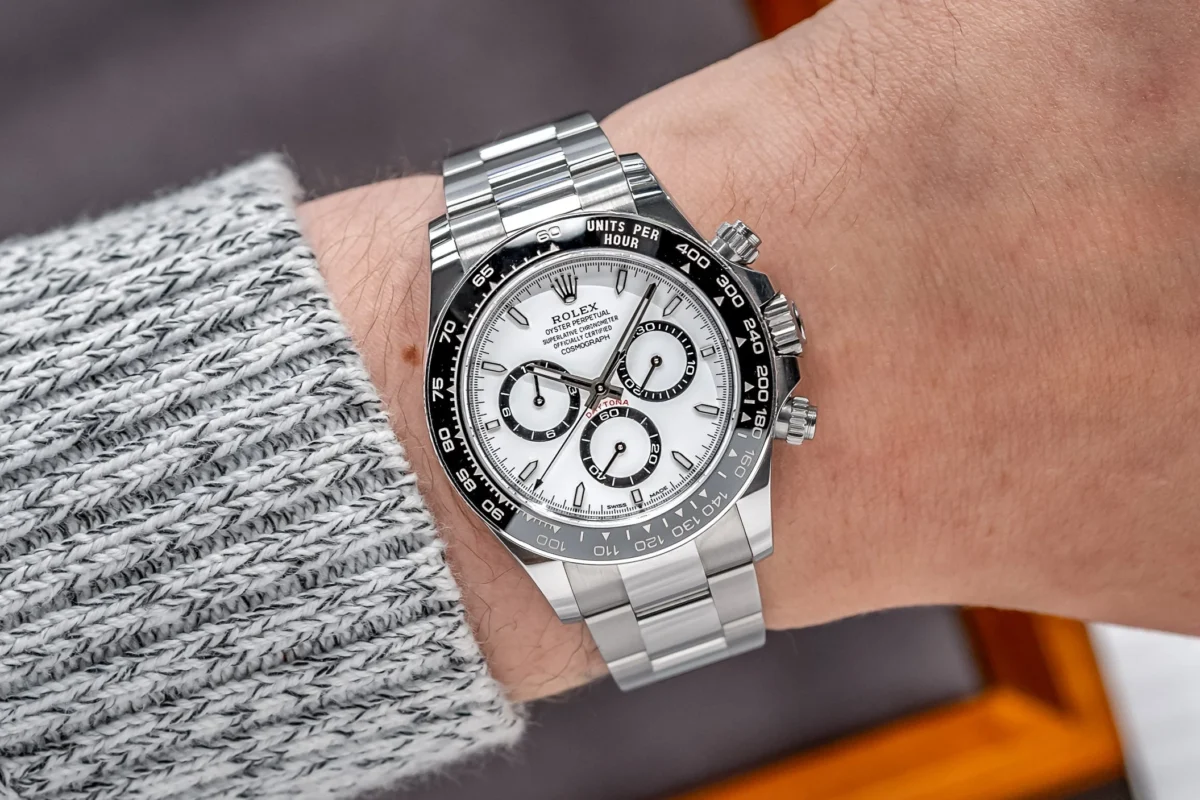
The 116500LN was replaced in 2023, making it a “previous generation” watch — but that hasn’t hurt its market standing. Clean, unpolished, full-set examples still trade at $28,000–$40,000. The white dial “panda” variant and the black dial “reverse panda” trade at near-identical pricing — neither commands a consistent premium over the other in the current market.
126500LN (2023–Present)
The current-generation Daytona brings several meaningful changes. The Caliber 4131 replaces the 4130 with improved regulation, a longer power reserve of 72 hours, and updated serviceability. The case has a refined lug profile with more sophisticated finishing — a subtle but visible improvement when you see both generations side by side. The Oyster bracelet received an updated Oysterlock clasp and Easylink comfort extension.
Secondary market pricing currently runs $32,000–$45,000 for clean full-set 126500LN examples — a modest but consistent premium over the 116500LN. For buyers who prioritise having the current reference and the newest movement, the 126500LN is the clear choice. For buyers who are price-conscious and happy with the previous generation, the 116500LN offers excellent value.
Both are correct choices depending on priorities. This Rolex Daytona buying guide doesn’t declare a winner — it depends on what matters most to you.
Looking for a specific Daytona configuration? Tell us exactly what you want — reference, dial colour, generation, condition tier — and we’ll source it. Standard Daytona sourcing takes two to four weeks for a full-set, unpolished example.
Dial Choice: White Panda vs Black Reverse Panda
Every Rolex Daytona buying guide eventually comes down to dial choice. For the steel references, you choose between the white dial with black subdials — known in the collector community as the “panda” dial — and the black dial with white subdials, the “reverse panda.”
The honest answer: this is personal and there is no wrong choice. Market pricing for comparable condition and generation examples is nearly identical for both dials — neither trades at a meaningful premium over the other in 2026. Buy the one you want to look at every day for the next decade.
What does vary: vintage reference opinions. For buyers who are also interested in how this watch fits into the longer Daytona heritage, the panda dial has more historical precedent — most of the legendary vintage Daytona references that built the model’s reputation wore light dials with dark subdials. That context matters to some collectors and not at all to others.
What Full Set Means for the Daytona — and Why It Matters More Here Than Anywhere Else
On a Submariner or a GMT-Master II, full set (box and papers) typically adds $1,500–$3,000 to market value. On a Daytona, the premium for full set is higher — often $4,000–$8,000 — for two reasons: collector standards for the Daytona are more exacting than almost any other Rolex reference, and the watch’s investment case is stronger, meaning buyers are more careful about documentation that protects resale value.
The papers in question are the Rolex Guarantee card — the warranty card filled with a purchase date and dealer stamp. For 116500LN examples purchased between 2016 and 2022, a green card is standard. For the 126500LN (2023 onward), Rolex switched to a credit-card-format Guarantee. Both are valid and both matter to buyers.
The practical advice in this Rolex Daytona buying guide on this point is simple: buy full set if you can afford to. A watch-only Daytona is not unsellable, but you will feel the documentation gap clearly when the time comes to sell, and the discount you get at purchase often doesn’t fully compensate for that gap at exit. If the full-set premium is genuinely outside your budget, at minimum ensure the serial number is verifiable and the watch itself is in excellent unpolished condition.
Authentication: What Counterfeits Look Like on the Daytona
Any serious Rolex Daytona buying guide has to cover authentication, because the Daytona is the most counterfeited Rolex reference in existence. The premium it commands makes it worth the effort for counterfeiters at every level — from obvious fakes to high-quality replicas designed to deceive. Key things to check:
- Subdial execution. Genuine Daytona subdials have perfectly sharp text, correct typeface weight, and precisely placed printing. Fakes commonly show slight blur under a loupe, incorrect font weight, or subdial text that doesn’t align correctly with the register positions.
- Ceramic bezel tachymeter. On a genuine 116500LN or 126500LN, the tachymeter scale is laser-engraved directly into the ceramic and filled with platinum. Under a loupe it sits flush with the ceramic surface. Fakes frequently have painted or printed scales that sit slightly proud of the surface or have uneven platinum fill.
- Serial and reference engraving. On genuine post-2005 Rolex, the serial number is laser-engraved between the lugs at 6 o’clock and repeated on the rehaut (the inner edge of the dial bezel). The engraving should be crisp, fine, and perfectly consistent in depth. Fakes often have shallow, stamped, or inconsistent engravings.
- Caseback finishing. The Daytona caseback is smooth and domed with the Rolex logo etched subtly at the centre. It is not see-through. Any watch presented with a display caseback claiming to show the movement is not a genuine Daytona.
- Movement verification. A professional authenticator can open the case and verify the Caliber 4130 or 4131 architecture. Do not open it yourself, but for a $30,000+ purchase, a one-hour professional examination costing $150–$300 is money exceptionally well spent.
For any Daytona purchase from a private seller or an unknown source, third-party authentication is not optional — it’s a basic requirement. The risk at these price points is simply too high to skip it.
Sourcing a Daytona: What to Realistically Expect
This section of the Rolex Daytona buying guide is where most buyers need the most honest information. Here is what actually happens across the different sourcing channels.
Authorised Dealers
As covered earlier: the AD route for a steel Daytona is not a realistic short-term strategy for most buyers. Walk into any Rolex boutique as a new customer and ask for a Daytona — the answer will be some version of “we don’t have a waitlist” or “we allocate to existing clients.” That’s not unhelpfulness, it’s the reality of how Rolex manages supply at the retail level. Building an AD relationship for future Daytona allocation is worth doing if you’re a long-term collector, but it is a multi-year project, not a purchase pathway for 2026.
Secondary Market and Specialist Dealers
Reputable specialist dealers are the most practical route. They hold authenticated inventory, provide documentation, and stand behind the watches they sell. Pricing will be at or above the secondary market ranges in this guide. The premium over a private sale is the cost of authentication, dealer guarantee, and the certainty that you have genuine recourse if something is wrong.
For sourcing a specific configuration — a particular dial colour, a full-set requirement, or a specific generation — a concierge approach works well. You specify exactly what you want and the specialist finds it. Standard sourcing time for a full-set steel Daytona in excellent condition runs two to four weeks through our network at Crown Watch Group.
Private Sales
Private sales can produce better pricing than specialist dealers, but the authentication risk is entirely yours. If you go this route: use a professional authenticator before completing any transaction, insist on a serial number before agreeing to view the watch, and never transfer funds before physical inspection is complete. Private Daytona transactions that go wrong are painful and difficult to resolve.
The Daytona as an Investment: Honest 2026 Outlook
No Rolex Daytona buying guide should overclaim on investment returns, so here is an honest picture.
The historical case is strong. The 116520 (the pre-ceramic steel Daytona, produced 2000–2016) traded at retail around $11,000. It now commands $18,000–$28,000 for excellent examples. The 116500LN retailed at $12,400 in 2016 and now trades at $28,000–$40,000. These are meaningful, documented returns over multi-year hold periods.
The forward outlook is less certain. Secondary market watch prices corrected significantly in 2022–2023 after the post-pandemic spike, and the steel Daytona was not immune. Prices have stabilised and are moving upward again in 2026, but the era of rapid year-over-year appreciation that characterised 2020–2021 is not the baseline expectation.
What supports the Daytona’s long-term investment case: Rolex’s supply constraint is a deliberate and long-standing policy; the reference has cultural and historical depth that most watches don’t; and global demand from new collector markets continues to expand. The Daytona is as strong an investment watch as exists in 2026 — but buy it because you want to own it, and treat any appreciation as a welcome bonus rather than a guaranteed return. Rolex’s official Daytona page covers the technical history and current specifications if you want the manufacturer’s perspective alongside this guide.
Rolex Daytona Buying Guide: Full Condition Checklist
Before purchasing any Daytona — whether through a dealer, privately, or via a concierge service — run through this checklist.
| What to verify | Why it matters |
|---|---|
| Box and papers present | Protects full resale value; Daytona papers premium is $4,000–$8,000 |
| Serial number verified | Confirms genuine Rolex, confirms reference year, detects frankenwatches |
| Unpolished case and bracelet | Original surface finish commands a strong collector premium; polishing destroys resale value |
| All bracelet links present | Missing links are irreplaceable at retail; their absence reduces value and wearability |
| Subdial text under loupe | First authentication check; genuine printing is perfectly sharp and correctly weighted |
| Ceramic bezel tachymeter | Platinum fill should be flush and consistent; raised or uneven fill indicates a fake |
| Rehaut engraving | Serial number should repeat cleanly on the inner bezel edge — depth and crispness confirm genuineness |
| Caseback — no display back | Any display caseback on a “Daytona” means it is not a genuine Daytona |
| Returns policy confirmed | Never complete a transaction without a documented returns pathway if the watch is misrepresented |
Frequently Asked Questions: Rolex Daytona Buying Guide
What is the best Rolex Daytona to buy in 2026?
For most buyers, the steel Daytona — either the current 126500LN or the previous-generation 116500LN — is the right starting point. The 126500LN is the stronger investment choice as the current reference; the 116500LN offers better value per dollar at slightly lower entry pricing. Both are excellent watches. Dial colour (white panda vs black reverse panda) is personal preference — neither trades at a consistent premium.
How long is the wait for a Rolex Daytona at an authorised dealer?
At most ADs, there is no formal waitlist for the Daytona — allocations go to established clients with significant purchase history at that specific boutique. For a new customer, a realistic timeline for a steel Daytona allocation is four to seven years, if it happens at all. The secondary market and concierge sourcing are the practical alternatives.
How much should I pay for a Rolex Daytona in 2026?
For a clean, full-set, unpolished 126500LN: $32,000–$45,000. For a 116500LN in comparable condition: $28,000–$40,000. Any price significantly below these ranges for a full-set example should be treated as a serious red flag. Significant underpricing on a Daytona is not a bargain opportunity — it is a warning sign.
Is the Rolex Daytona a good investment in 2026?
The long-term investment case is strong, supported by consistent supply constraints and deep collector demand. Short-term returns are less predictable following the 2022–2023 market correction. Buy it because you want to own and wear it; treat any appreciation as a bonus. Over five-plus year hold periods, the Daytona has historically been one of the most reliable appreciating watches available.
Where can I buy an authenticated Rolex Daytona without a waitlist?
Through a specialist Rolex dealer or concierge sourcing service. At Crown Watch Group, we source Daytona references to specification across our global dealer network — submit your exact requirements here and we’ll come back with a sourcing timeline and current pricing.
The Bottom Line: Rolex Daytona Buying Guide 2026
The Daytona is genuinely one of the great watches — and genuinely one of the hardest to source. This Rolex Daytona buying guide gives you the full picture: what the references are, what they cost, what to verify before you buy, and how to approach the purchase without waiting years for an AD allocation that may never come.
If you’re ready to move, submit a Daytona request with your exact specification — reference, dial, generation, condition tier. We source actively and move quickly when the right example comes through. Or browse our current inventory — we update it daily and pieces move fast.
Ready to Source Your Rolex?
Let Us Find the Watch You've Been Looking For
No waitlists. No guesswork. Authenticated Rolex watches sourced directly for you.
Request a Watch