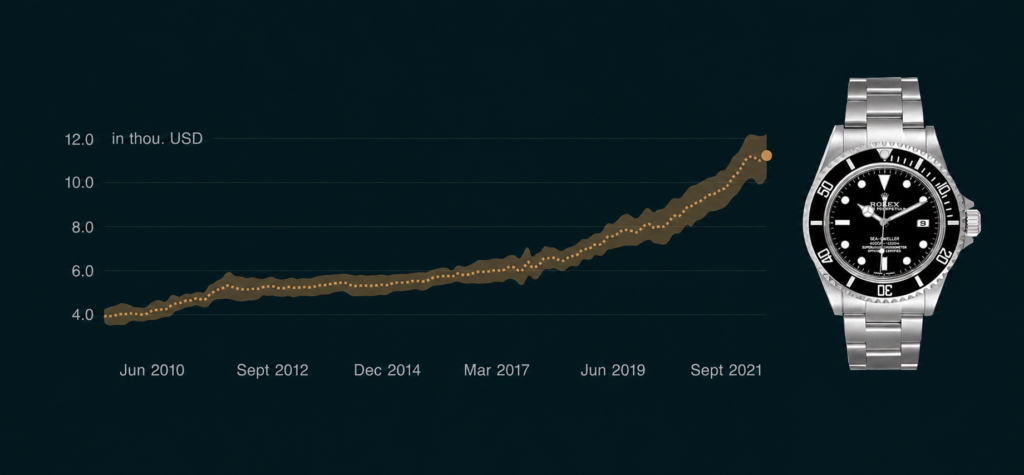
The best Rolex models to buy as investments aren’t a secret — but they’re not what most people expect when they first research the topic, either. I get calls every week from buyers who’ve convinced themselves a Datejust or a Day-Date is a solid investment because “Rolex always holds value.” It doesn’t work that way. The brand name gets you a very good watch. The reference determines whether it appreciates. Those are two entirely different things, and conflating them is the mistake that leads to overpaying for the wrong piece.
I’ve been in this business long enough to have seen people buy at the 2022 peak, panic when prices corrected, and sell at a loss — on references that had no business being bought as investments in the first place. I’ve also watched buyers who bought the right references in 2018 and 2019 sit on 80–150% gains without lifting a finger. The difference between those two outcomes was almost entirely which reference they chose. So let’s talk about that.
Before we get into the ranking, check our current inventory for live secondary market pricing on all of these references. Prices move, and what you’re reading here is based on 2026 transaction data — not estimates.
What Actually Makes a Rolex a Good Investment
There’s one mechanism behind every appreciating Rolex reference, and once you understand it, identifying the best Rolex models to buy as investment becomes straightforward. It comes down to this: when an authorised dealer can hand you a watch today, there’s no secondary market premium. When they can’t — when there’s a three, four, or five-year waitlist standing between you and the watch — the secondary market steps in and charges a premium for immediacy. That’s the whole thing.
Rolex maintains those supply gaps deliberately. They have the production capacity to make more Daytonas. They choose not to. It’s policy, not limitation. And because the policy has been consistent for thirty-plus years, it’s created what is effectively a structural investment case — not a trend, not a bubble, but a persistent supply-demand imbalance that the secondary market prices accordingly.
Every reference on this list has that imbalance. None of the references at the bottom of the article do. That’s the only criterion that matters here.
The Best Rolex Models to Buy as Investment in 2026: The Ranking
1. Rolex Daytona Steel — Ref. 126500LN (and outgoing 116500LN)
There’s no real contest at the top. When people ask me which are the best Rolex models to buy as investment and want a single answer, I say the Daytona. Every time. Not because I’m trying to be simple about it, but because the data over thirty years is clearer on this reference than on anything else in the catalogue.
The 116500LN — the ceramic bezel steel Daytona that launched in 2016 — entered the market at $12,400. It trades today at $28,000–$38,000. That’s a 125–207% return over eight years, and that’s for a watch you could have been wearing the whole time. The current generation, the 126500LN, launched in 2023 at $16,550 and immediately cleared $28,000 on the secondary market. It hasn’t looked back.
What makes this remarkable isn’t just the numbers — it’s the consistency. The Daytona held its premium through the 2022–2023 market correction that wiped 20–30% off many other references. It’s held it through two recessions, through market volatility, through everything. The authorised dealer waitlist at most boutiques globally sits at five years minimum. Some buyers wait longer. That kind of structural imbalance doesn’t resolve quickly, and it won’t resolve soon.
There’s also a cultural depth to the Daytona that reinforces the investment case. It was designed as a motorsport timing instrument in the early 1960s. Its vintage “Paul Newman” dial references have sold at auction for millions. The watch has half a century of genuine story behind it — and that story is what separates an asset with lasting value from a fashion item that appreciates and then corrects.
Investment grade: A+ | 2026 secondary market: $28,000–$40,000 | Retail: $16,550
2. GMT-Master II Batman — Ref. 126710BLNR
The Batman launched in 2019 at $9,700 and has never looked back. It currently trades at $17,000–$24,000, and the Jubilee bracelet version — the one collectors call the Batgirl — sits at the upper end of that range or beyond. The premium above retail has held above 60% continuously since launch, through the 2022 correction and out the other side.
I want to be specific about the bracelet here because it genuinely matters for investment purposes. The Oyster and Jubilee variants share the same reference number (126710BLNR), but the Jubilee commands a $2,000–$4,000 premium on the secondary market, consistently. That preference has been stable for four years now. If you’re buying this reference as an investment, buy the Jubilee. It finds a buyer faster and sells higher. I’ve seen this play out enough times that I feel comfortable saying it plainly.
The GMT also benefits from being the more versatile daily watch of the sport references. Collectors who wear their investments often choose the GMT over the Daytona for exactly this reason — it wears like a sport watch and looks right across a much wider range of situations. The demand is broad.
Investment grade: A | 2026 secondary market: $17,000–$24,000 | Retail: $10,700
3. GMT-Master II Pepsi — Ref. 126710BLRO
The Pepsi trades at a consistent premium over the Batman — typically $3,000–$6,000 more at equivalent condition — and the reason is simple: seventy years of history is in that red and blue bezel. The GMT-Master launched in 1955 as a Pan Am pilot’s watch with that exact colour scheme. The Pepsi nickname has been in use since the 1980s. Every serious watch collector in the world knows what it is before you even say the reference number.
Current pricing sits at $18,000–$27,000 against a $10,700 retail. The premium is higher than the Batman and has historically been more resilient during market downturns. In 2022, when a lot of references corrected significantly, the Pepsi barely moved. That kind of behaviour during stress tells you something important about the quality of demand behind a reference.
The Pepsi comes exclusively on a Jubilee bracelet in the current generation, which removes the bracelet decision entirely. If you want the best Rolex models to buy as investment at the GMT level and the Pepsi is within your budget, this is marginally the stronger investment choice between the two GMT variants.
Investment grade: A | 2026 secondary market: $18,000–$27,000 | Retail: $10,700
We source all five of these references regularly. Browse available inventory or submit a request with your preferred reference and configuration. We’ll give you a sourcing timeline and current pricing with no obligation.
4. Submariner Date Kermit — Ref. 126610LV
The green-bezel Sub is my pick for buyers who want a strong daily-wear watch and a genuine investment in one. It consistently outperforms the standard black-bezel 126610LN on the secondary market — not by a dramatic margin, but reliably, which is what you want from an investment. It trades at $14,500–$18,500 against a $10,800 retail price.
The reasoning is the same as everywhere else on this list: the 126610LV receives slightly fewer authorised dealer allocations than the standard black model, and the collector preference for the green bezel creates consistent excess demand. It’s not as dramatic a gap as the Daytona or the Pepsi, but it’s real and it’s durable.
Something else worth mentioning: the Submariner is the most liquid reference in the entire Rolex secondary market. If you ever need to sell quickly, a Kermit in good condition with papers moves faster than almost anything else. That liquidity has real value if your circumstances change.
Investment grade: A- | 2026 secondary market: $14,500–$18,500 | Retail: $10,800
5. Explorer II Polar — Ref. 226570
This is the right answer for buyers who look at the prices above and want something investment-grade without committing $25,000 or more at secondary market rates. The Explorer II Polar launched in 2021 at approximately $8,550 and currently trades at $10,500–$13,000. That’s a 23–52% premium — more modest than the others, but it’s been consistent and the trend has been upward rather than volatile.
The entry cost is lower. The downside risk is proportionally smaller. And the watch has a strong identity — the white “polar” dial Explorer II has a distinct collector following and a genuine history as a caving and expedition watch. If you’re buying your first investment-grade Rolex, this is a sensible place to start.
Investment grade: B+ | 2026 secondary market: $10,500–$13,000 | Retail: ~$8,550
Best Rolex Models to Avoid as Investments
These are good watches. Some of them are great watches. But they don’t belong on any list of the best Rolex models to buy as investment, and it’s worth being clear about why:
| Reference | The Reality |
|---|---|
| Datejust 41 (standard steel configurations) | No waitlist, highest supply of any Rolex — trades at or below retail for common dials. Buy because you want it, not to profit. |
| Oyster Perpetual (standard colours) | Had a speculative spike in 2020–2021. That’s over. Now near retail. Anyone who bought at the peak is still waiting to break even. |
| Day-Date (yellow gold, standard dials) | The precious metal value is priced in — there’s no scarcity premium on top of it. Near retail on the secondary market. |
| Lady-Datejust | Broad supply, narrower buyer pool, minimal secondary premiums across almost all configurations. |
| Sky-Dweller (most configurations) | Complex movement, higher retail price, but secondary market premiums are thin and inconsistent. Buy for the watch, not the returns. |
A lot of buyers ask me about the Oyster Perpetual because they remember the 2021 stories — the coral dial OPs trading at 80–100% above retail, people camping outside boutiques. That was real. It was also a trend premium, not a structural one. The underlying watch had no waitlist, plenty of supply, and no decades-long collector story behind it. When sentiment shifted, the premium evaporated. That’s the exact pattern you want to avoid when thinking about the best Rolex models to buy as investment.
Condition Grades and What They Mean for Your Investment
This section matters more than most buyers realise, and I’ve watched people lose real money by ignoring it. Two examples of the same reference can differ by $4,000–$6,000 based purely on condition. Here’s how to think about it:
Unworn or like-new. The top of the market. Full set, original stickers sometimes still on, bracelet links tight with no stretch. This is where you pay the most and where you’ll find the most interest from serious buyers when you sell. Worth paying for if investment is the primary goal.
Excellent, unpolished. The sweet spot for most investment buyers. The watch has been worn — maybe regularly — but the original brushed and polished case surfaces are intact. No watchmaker has touched the exterior. This is the grade I personally target most often when buying for clients, because you get meaningful value versus unworn pricing while keeping the collector premium.
Good, light wear, polished. Here’s where it gets complicated. A watchmaker-polished Rolex case has lost its original surface finishing permanently. The alternating matte and polished surfaces that Rolex applies at the factory are gone. Collectors notice this immediately, and it shows in the price — typically $1,000–$3,000 below an unpolished equivalent. Never request polishing during a service on an investment-grade piece. It seems like a nice idea and it’s a permanent deduction from your resale value.
Papers and original box. On all the references in this ranking, a full set — watch, outer box, inner box, warranty/guarantee card with purchase date, hangtags, and accessories — adds $1,500–$3,500 versus a watch-only example. Always buy the full set when you can. On resale, it makes the sale faster and the price higher. I’ve never once regretted buying a full-set example over a watch-only example.
How to Actually Buy These Watches in 2026
There are three real options for acquiring the best Rolex models to buy as investment in 2026:
Authorised dealer route. Works eventually, but not on any timeline that’s useful for most buyers. The steel Daytona has an effective waitlist of five-plus years at most boutiques. The GMT references run three to four years. If you have an existing AD relationship and have been buying regularly, you may see one of these references sooner. Most buyers don’t have that relationship, and building it takes years. Not a plan if you want the watch this decade.
Secondary market — direct or platform. Chrono24 and similar platforms aggregate secondary market listings globally. You’ll find the references here, but you’re doing your own authentication, your own negotiation, and your own due diligence. The risk is real. Super-clone fakes are sophisticated. Misrepresented condition is common. Frankenwatch assemblies — genuine cases with non-genuine dials or movements — are harder to detect than most buyers expect.
Specialist dealer or concierge. This is how I’d recommend any serious investment buyer approach it. A specialist who sources actively, authenticates professionally, and stands behind every piece they sell gives you the pricing transparency of the open market with the protection of working with someone whose reputation depends on getting it right. At Crown Watch Group, every watch we present has been through a multi-step authentication process before a buyer sees it. That’s not marketing — it’s the only way I’m comfortable selling a $25,000 watch to someone I want to work with again.
2022 Peak vs. 2026: What the Correction Means for Buyers Now
I want to spend a minute on this because it comes up in nearly every conversation I have with first-time investment buyers. The market peaked in mid-2022. Prices for most references dropped 15–25% from those highs by late 2023. Some buyers interpret this as a signal that the investment case is broken. I think that’s wrong, and here’s why.
The 2021–2022 peak was partly structural demand (still real) and partly speculative frenzy driven by pandemic-era consumer behaviour, excess liquidity, and a general “everything appreciates” market environment. When that frenzy cleared, prices corrected back toward rational premiums. The Daytona, Batman, and Pepsi — the strongest structural references — held their premiums better than anything else. The Oyster Perpetual, which had only speculative demand behind it, corrected almost entirely back to retail.
What we’re left with in 2026 is a secondary market pricing references on genuine supply-demand fundamentals rather than hysteria. That’s actually a healthier environment for investment buyers than the 2021 peak was. You’re paying rational prices for real scarcity, not speculative prices for trend momentum. If I were building a position in the best Rolex models to buy as investment today, I’d be more comfortable with the current pricing than I would have been at peak.
Considering a specific reference? Browse current inventory or tell us exactly what you want — reference, configuration, condition — and we’ll come back to you with current pricing and a sourcing timeline. No pressure, no obligation.
Frequently Asked Questions
What are the best Rolex models to buy as investment in 2026?
The five references with the strongest investment case in 2026 are: the steel Daytona (126500LN), the GMT-Master II Batman on Jubilee (126710BLNR), the GMT-Master II Pepsi (126710BLRO), the Submariner Kermit (126610LV), and the Explorer II Polar (226570). All five have multi-year AD waitlists and consistent secondary market premiums above retail.
Which Rolex model has the best return on investment?
The steel Rolex Daytona, across both the outgoing 116500LN and current 126500LN generations, has the strongest documented return on investment of any current production reference. The 116500LN has appreciated 125–207% since its 2016 retail introduction. No other reference in the catalogue comes close over the same timeframe.
How much do Rolex watches appreciate?
Investment-grade references have appreciated 50–220% above retail over their production runs. The Daytona is at the high end of that range. The Submariner is at the lower end but benefits from superior liquidity. Standard references like the Datejust typically trade at or below retail — there’s no meaningful appreciation on references that have no AD waitlist.
Is it better to buy a Rolex new or pre-owned for investment?
Pre-owned at a fair secondary market price is often the better investment entry point in practice. Buying new at retail requires years on an AD waitlist for investment-grade references, and most buyers simply don’t have that relationship or timeline. A well-priced pre-owned example in excellent unpolished condition with full documentation often represents a cleaner, more controlled entry.
Do you need box and papers for a Rolex to hold investment value?
You don’t need them to sell — but you’ll feel the absence. On a Daytona or GMT-Master II, a full set adds $1,500–$3,500 to secondary market value. Papers confirm provenance and simplify authentication for future buyers. If you’re buying for investment, always buy the full set when it’s available. The additional cost is almost always recovered on the other side.
Is the Rolex GMT-Master II Sprite worth buying as an investment?
The Sprite (Ref. 126720VTNR) — the left-crown GMT with green/black bezel — is showing early investment signals. It’s trading at $18,000–$28,000 against an ~$11,000 retail price. Too early for a full investment grade, but it’s one to watch. Buyers who got in at launch in 2022 are sitting on meaningful unrealised gains.
The Bottom Line
If someone asks me to name the best Rolex models to buy as investment and I have thirty seconds to answer, I say: Daytona, Batman GMT on Jubilee, Pepsi GMT, Kermit Sub, Explorer II Polar. In that order, for investment purposes, in 2026.
Everything else is a watch purchase, not an investment. That’s a perfectly valid reason to buy — I’d never tell someone not to buy the Datejust they’ve wanted for twenty years because it doesn’t appreciate. But if appreciation matters to the decision, reference selection is the entire ballgame, and the five above are where the case is strongest.
If you’re working toward one of these, we source all five regularly. Browse available inventory or submit a sourcing request for the specific configuration you want — and we’ll come back to you with current pricing and a realistic timeline.
Ready to Source Your Rolex?
Let Us Find the Watch You've Been Looking For
No waitlists. No guesswork. Authenticated Rolex watches sourced directly for you.
Request a Watch