Learning how to authenticate a Rolex is the most important thing a secondary-market buyer can do before handing over money. Doesn’t matter if you’re buying from a private seller, a marketplace listing, or even a dealer — the secondary market has genuine watches, counterfeits, and franken-watches (real cases with non-original components), and they don’t announce themselves. You have to know what you’re looking at.
The good news is that knowing how to authenticate a Rolex at a functional level doesn’t require a watchmaking qualification. It requires knowing which nine things to check, where to look, and what discrepancies actually mean. That’s what this guide covers.
We’ll go through every checkpoint — the reference number between the lugs, the dial, the bezel, the movement, the documentation, all of it — and explain what genuine looks like and what raises red flags. By the end, you’ll know how to authenticate a Rolex well enough to identify problems before committing to a purchase, and you’ll know when a situation calls for professional verification.
Why This Matters More Than Most Buyers Realise
The stakes for getting how to authenticate a Rolex wrong are high and getting higher. A Submariner Date trades between $10,000 and $16,000 in 2026. A Daytona between $28,000 and $48,000. A GMT-Master II Batman in the $17,000 to $24,000 range. These aren’t impulse purchases where a mistake is easily absorbed.
And the problem isn’t just outright fakes — though those exist. The more common issue is franken-watches: a genuine Rolex case fitted with a non-original dial, a real dial in a mismatched case, a legitimate movement with the wrong bracelet for the reference. These watches are genuinely “real” in some sense, but they’re not what they’re being presented as, and they’re priced incorrectly relative to what they actually are.
Knowing how to authenticate a Rolex means catching both: the fakes and the franken-watches. And the checklist for catching both is largely the same.
How to Authenticate a Rolex: The 9 Checkpoints
Work through these in order. Each one builds on the previous. Don’t skip the early checks because they feel basic — the reference number verification underpins everything else.
Checkpoint 1: The Reference Number Between the Lugs
Start here. Always. The reference number engraved between the lugs — at the 6 o’clock side of the case, in the space between the case body and the bracelet end link — is the most important single piece of information in how to authenticate a Rolex. Everything else gets cross-checked against this number.
The reference number identifies the exact model variant. A 126610LN is a Submariner Date with a black Cerachrom bezel and black dial. A 126610LV is the “Kermit” with a green Cerachrom bezel. A 126500LN is the current-generation Daytona with a ceramic bezel. Each reference maps to specific case dimensions, dial configurations, bracelet types, and movement calibers. If any of those don’t match, you have a problem.
Getting a clear photo of this engraving is the first thing you should ask for in any secondary-market transaction. If a seller won’t provide it — or provides a blurry, obstructed image — that’s a hard stop. Don’t proceed without it. This is non-negotiable when working out how to authenticate a Rolex remotely from photographs.
What genuine engraving looks like: fine, clean, precisely spaced characters with sharp edges. What to be suspicious of: stamped or punched characters, uneven depth, inconsistent spacing, or an engraving that looks rougher than the surrounding case surface.
Checkpoint 2: The Serial Number
The serial number on modern Rolex references (post-2005) lives on the inner bezel at 12 o’clock — visible when the bracelet is removed from the case. On older references, it’s between the lugs at the 12 o’clock side. This number does two things in how to authenticate a Rolex: it places the watch’s production within a specific year range, and its engraving style confirms genuine manufacture.
Cross-reference the serial number against known Rolex production tables — collector communities maintain these — to confirm the production year is consistent with the reference. A watch with a serial indicating 2015 production but a reference that wasn’t introduced until 2020 is definitively problematic. So is the reverse: a reference from 2008 with a serial suggesting 2022 production.
The engraving quality should match the reference number: fine, precise, consistent. Rolex doesn’t stamp serial numbers — they’re machine-engraved with consistent depth and spacing. Any variation from this in a watch you’re evaluating is a red flag worth investigating before going further in the authentication process.
Checkpoint 3: The Dial
This is where most experienced buyers spend the most time when working through how to authenticate a Rolex. The dial is the most commonly modified component in franken-watches and the most expensive element to replicate well in counterfeits. Get it right here and you’ve eliminated most of the risk.
Several things to check:
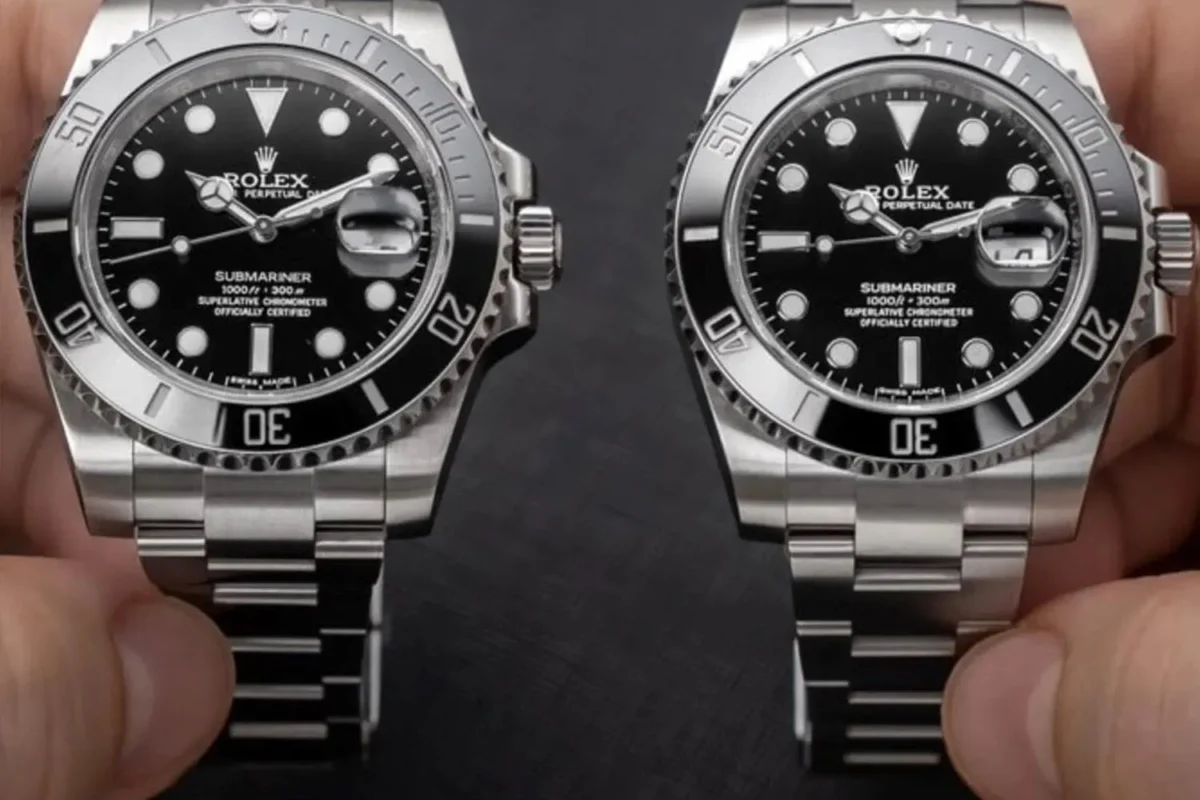
The text. “ROLEX”, the model name, “SUPERLATIVE CHRONOMETER OFFICIALLY CERTIFIED”, “SWISS MADE” — every character on a genuine Rolex dial is laser-applied with precision that shows up clearly under a loupe or in a good macro photograph. The edges of each character are sharp. There’s no blurring, spreading, or inconsistency between characters on the same line. Counterfeits fail here more often than anywhere else because reproducing this quality of printing requires the same equipment Rolex uses.
The Rolex coronet at 12 o’clock. The Rolex crown logo should be precise — clean, fine points, correct proportions. Under magnification, a genuine coronet has the same quality as the dial text. Rounded, bloated, or slightly asymmetric crowns on counterfeits are common tells.
The lume plots. The luminescent hour markers should be consistent in size, shape, alignment, and fill. Genuine lume plots on a modern Rolex are applied with precision — even edges, uniform fill, consistent aging across all plots on an older watch. Uneven plots, different-sized markers in the same position across dial variants that should be identical, or lume that sits proud of the surface in an uneven way — all worth flagging.
Surface texture. A sunburst dial has a specific radial texture from centre to edge. A matte dial has a uniform grain. Get a photo at a 45-degree angle to the dial face under direct light — this reveals the surface texture in a way that flat-on photographs don’t. Reproductions rarely match the genuine texture exactly.
Checkpoint 4: The Hands
Hands are a common swap point in franken-watches. In how to authenticate a Rolex, checking the hands involves three things: proportions, finishing, and lume consistency with the dial.
The hands must be correctly proportioned for the specific reference — each model has defined hand dimensions and shapes that can be compared against verified references. The finishing must match: brushed tops, polished sides, or the specific finishing pattern defined for that reference. And crucially, the lume fill in the hands must age at the same rate and to the same colour as the dial lume. A set of hands with significantly different lume aging from the dial almost certainly came from a different watch.
Also check that the second hand — where applicable — is precisely centred on the dial axis. An off-centre second hand indicates either damage or a non-original hand fitted without proper alignment.
Checkpoint 5: The Bezel
For modern Rolex sport references with Cerachrom ceramic bezels, this checkpoint in how to authenticate a Rolex is one of the cleaner tests available. Genuine Cerachrom has a specific, deep colour saturation that’s extremely difficult to replicate convincingly. Aftermarket ceramic inserts typically show either slightly incorrect colour, insufficient depth of saturation, or surface texture that differs from genuine under magnification.
The text infill on genuine Cerachrom bezels — the numerals and markings — is filled with platinum on steel references and gold on precious metal versions. This fill sits flush with the ceramic surface and has a specific metallic quality. Paint-filled aftermarket inserts sit slightly proud of the surface and lack the metallic lustre of genuine PVD-filled engravings.
On a rotating bezel (Submariner, GMT), the action should be smooth and positive — a clean click with no play or looseness. A bezel that moves without clicking, or wobbles in its housing, suggests a replaced insert that doesn’t fit the case correctly.
For older references with aluminium inserts: some colour fading is normal and expected with age. But fading must be consistent around the entire insert. Patches of different fading on a single insert — or an insert that looks dramatically newer than the case — indicate replacement.
Checkpoint 6: The Case and Case Back
The case is expensive to replicate well. In how to authenticate a Rolex, case quality is often where high-end counterfeits give themselves away under close inspection, even when the dial passes at a glance.
Rolex uses a specific pattern of brushed and polished surfaces on each reference, and the transitions between them must be sharp and consistent. The centre bracelet links are polished; the outer links are brushed. The case flanks follow specific finishing patterns per model. Sloppy transitions, inconsistent finishing, or areas where polished surfaces bleed into brushed ones indicate either non-genuine manufacture or heavy polishing by a previous owner.
Speaking of polishing — ask about it directly. A watch that’s been polished loses metal from the case edges and lug tips, softening angles that are crisp on an unpolished example. This affects both the watch’s condition grade and its value. In how to authenticate a Rolex’s condition honestly, look for rounded lug edges and softened case angles as indicators of polishing history.
Most modern Rolex references have solid screwdown case backs with no display. Verifying the movement requires opening the case — something that needs a trained watchmaker with the right tools. For high-value purchases, this is worth paying for.
Checkpoint 7: The Bracelet and Clasp
Bracelets get overlooked surprisingly often in how to authenticate a Rolex. But they carry authentication information and are a common replacement point in franken-watches and modified pieces.
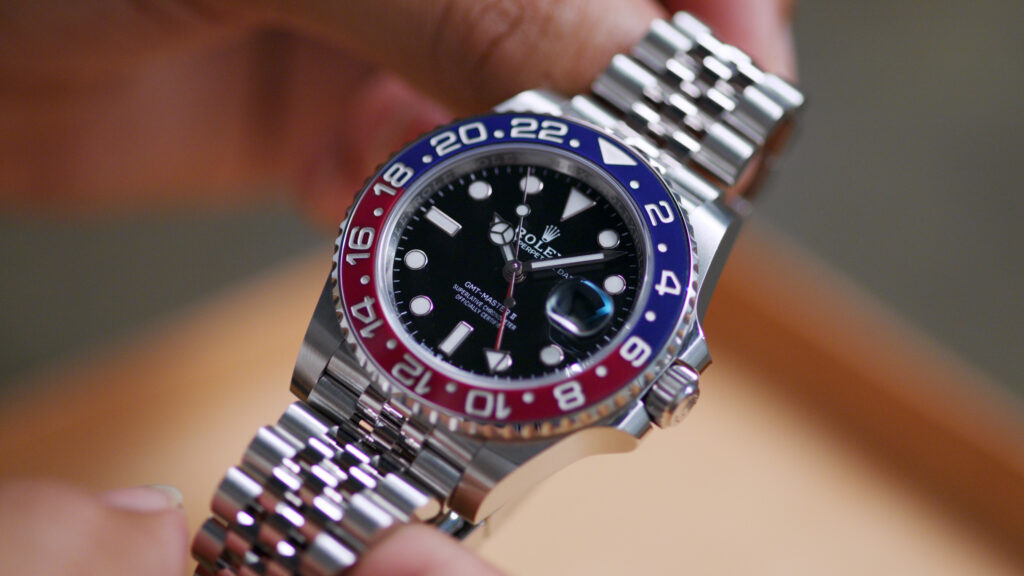
Verify that the bracelet type is correct for the reference. The Batman GMT-Master II 126710BLNR wears a Jubilee bracelet. The Submariner Date 126610LN wears an Oyster bracelet. Wrong bracelet for the reference is an immediate flag — and a common one in watches assembled from parts.
The end links — the bracelet pieces that attach directly to the case — should be solid on references where solid end links are standard, and should fit flush against the case with no visible gap. Hollow end links on a reference that should have solid ones, or gaps between the end link and the case, indicate a bracelet from the wrong reference period.
The clasp engraving on a genuine Rolex bracelet carries the Rolex crown and text at specific positions with consistent depth. Aftermarket clasps typically have softer engraving, slightly off positioning, or wrong typeface. Compare against verified reference images if you have any doubt.
Checkpoint 8: The Crown and Winding Tube
The winding crown at 3 o’clock is a small detail in how to authenticate a Rolex that reveals a lot. The Rolex crown logo on the outer face of the winding crown must be precisely engraved — same quality as the dial coronet, same fine points, same correct proportions. Under magnification, it should look identical in precision to every other Rolex engraving on the watch.
The crown tube — the threaded tube set into the case that accepts the crown on screwdown models — should sit flush with the case when the crown is screwed down. Any gap between the tube and the case, or a tube that sits proud of the case surface, indicates damage, non-genuine components, or improper service.
On a screwdown crown (standard on all sport Rolex references), the crown should thread and unthread smoothly with consistent resistance. A crown that won’t screw down fully, or that feels loose and rattles, suggests damage or a non-matching crown for the reference.
Checkpoint 9: The Documentation
Documentation doesn’t prove authenticity on its own — a genuine watch can have fraudulent papers, and genuine papers can be paired with a non-genuine watch. But documentation verification is an important part of how to authenticate a Rolex when box and papers are present and being used to justify the price.
The warranty card reference number must match the between-lug reference number exactly. Any discrepancy here means either the card or the watch has been switched — and either scenario is a problem.
Rolex has updated its warranty card format multiple times. The card format must match the approximate production period of the watch. A watch with a 2018 serial number but a 2010-format warranty card needs explanation. Cross-reference the documentation format against known examples from the same period — collector resources have detailed records of this.
The authorized dealer information on the warranty card can often be verified. The named AD should exist in the claimed country, and the purchase date should be consistent with the serial number’s production year range. These details can be spot-checked with a basic search.
How to Authenticate a Rolex From Photographs
Most secondary-market decisions start with a photo review — and knowing how to authenticate a Rolex from photographs is a practical skill that every buyer needs. Here’s the photo set you should request before considering any purchase:
| Photo | What It Tells You |
|---|---|
| Between the lugs at 6 o’clock (close-up) | Reference number — the single most important shot |
| Inner bezel at 12 o’clock (bracelet off) | Serial number and production year |
| Dial face, full frame, direct light | Text precision, coronet quality, lume plots |
| Dial at 45-degree angle | Surface texture, depth of printing, lume character |
| Case back | Case finishing, engravings, case back type |
| Bezel close-up | Colour saturation, text infill quality |
| Bracelet and clasp (open and closed) | Bracelet type, clasp engravings, end link fit |
| Warranty card and box | Reference match, format consistency |
| Full watch, multiple angles | Case proportions, overall condition, wear consistency |
A seller who refuses to provide any of these — particularly the between-lug reference photo — is not a seller you should continue dealing with. Every item in this photo list is a standard, reasonable request for any secondary-market Rolex transaction. Any resistance to providing them tells you something important about either the watch or the seller’s intentions.
Red flags that require you to stop: Price significantly below secondary market value for that reference and condition · No between-lug photo or a blurry/obstructed one · Reference number discrepancy anywhere in the watch · Pressure to decide within hours · Payment only through untraceable methods · Documentation reference doesn’t match the watch · Seller can’t answer basic questions about the watch’s history
When to Use a Professional Authenticator
Knowing how to authenticate a Rolex gets you most of the way there for most transactions. But for high-value purchases — anything above $20,000, so Daytonas, high-spec GMT variants, precious metal references — professional authentication is a sensible investment. Here’s what a professional can do that you can’t do from photos:
Open the case and inspect the movement. Caliber verification against the reference, examination of rotor quality and engraving, assessment of movement finishing — none of this is possible with the case closed. For references where movement integrity is critical (and it always is above a certain price), this is essential.
UV inspection of documentation. Alterations to warranty cards and other documents that aren’t visible under normal light show up clearly under UV. This catches altered dates, reference numbers, and dealer information that have been modified.
Precision measurement. Case dimensions can be measured against published Rolex specifications to within fractions of a millimetre. High-quality counterfeits often pass visual inspection but fail on precise measurements.
The cost of a pre-purchase inspection is modest relative to the transaction value. For a $30,000 Daytona, spending $150 to $300 on professional authentication before paying is a completely rational decision. Knowing how to authenticate a Rolex yourself reduces risk — professional authentication eliminates most of what remains.
How to Authenticate a Rolex When Buying Through a Concierge
The practical answer to how to authenticate a Rolex for many buyers is to work with a source that’s already done it and is accountable for the result. This is how Crown Watch Group operates.
Every watch we present to a client has been through all nine checkpoints in this guide. Watches that fail any check are declined and not presented. Clients receive a comprehensive photo set and a written condition report covering every element described here — before any commitment or payment is requested. Nothing moves until the client has reviewed and approved.
Our how it works page explains the full authentication process in detail. For clients who want to understand how to authenticate a Rolex themselves — either to verify independently or to buy directly in the future — our guide on how to buy a Rolex without the waitlist covers the secondary market comprehensively.
For Miami clients, our Rolex concierge Miami service allows in-person inspection of the physical watch before payment is finalised. It’s the clearest possible confirmation of what you’re actually buying — and a level of assurance that remote transactions, however well-photographed, can’t replicate.
Frequently Asked Questions: How to Authenticate a Rolex
Can I authenticate a Rolex without opening the case?
Yes — and most buyers do. Eight of the nine checkpoints in this guide don’t require case opening. Reference number, serial number, dial, hands, bezel, case and bracelet, crown, and documentation can all be verified externally. Movement inspection requires opening, which needs a trained watchmaker. For purchases above $20,000, a professional pre-purchase inspection including movement verification is worth requesting.
What’s a franken-watch and how do I spot one?
A franken-watch is assembled from components of multiple different watches — a genuine case with a replacement aftermarket dial, a genuine dial in a non-matching case, a genuine movement in the wrong housing. The way to catch them when learning how to authenticate a Rolex is systematic cross-checking: the reference number must match the dial, the serial must match the production year of the reference, the bracelet must be the correct type and bracelet clasp must be correct for the reference, and documentation must match the watch. Any component inconsistency flags a potential franken-watch.
Does box and papers guarantee the watch is authentic?
No. Documentation can be separated from its original watch and paired with a different piece — or with a fake. In how to authenticate a Rolex, documentation is supporting evidence, not proof. The only reliable authentication is physical inspection of the watch against all nine checkpoints. Papers that match a genuine watch strengthen the case — they don’t independently establish it.
Can a Rolex service centre tell me if my watch is authentic?
A Rolex authorised service centre will identify non-genuine watches in the intake inspection process — they see the movement when a watch comes in for service. However, they don’t provide pre-purchase authentication certificates for secondary-market buyers. If you’ve already purchased a watch and have doubts, taking it in for service is a reliable way to get an informed opinion. Before purchase, knowing how to authenticate a Rolex yourself or using a trusted concierge is the practical path.
How do I authenticate a Rolex bought online without seeing it in person?
Request the full photo set described in the table above. The between-lug reference number photo and the serial number photo are the absolute minimums — don’t proceed without them. For high-value purchases, request a video showing the crown action and the movement running. Use escrow payment that holds funds until you’ve received and inspected the physical watch. Better still, buy through a concierge that authenticates before presenting the watch to you — you get the security of professional authentication without navigating the secondary market yourself.
What do I do if I’ve bought a watch I now suspect is fake?
Take it to a Rolex authorised service centre immediately — they’ll tell you definitively during the intake inspection. If it’s confirmed non-genuine, document everything: the listing, all communications with the seller, payment records, and the service centre’s findings. Contact your payment provider if payment was made by bank wire or card. File a report with local consumer protection authorities and any relevant marketplace platform. The best outcome from this situation comes from acting quickly and documenting thoroughly. The clearest way to avoid it entirely is knowing how to authenticate a Rolex before you pay — which is why this guide matters.
Crown Watch Group authenticates every Rolex we source before presenting it to a client. Reference verification, dial inspection, movement caliber confirmation, documentation review — all done before you see the watch, let alone commit to buying it. Submit a sourcing request and let us handle the hard part.
Ready to Source Your Rolex?
Let Us Find the Watch You've Been Looking For
No waitlists. No guesswork. Authenticated Rolex watches sourced directly for you.
Request a Watch