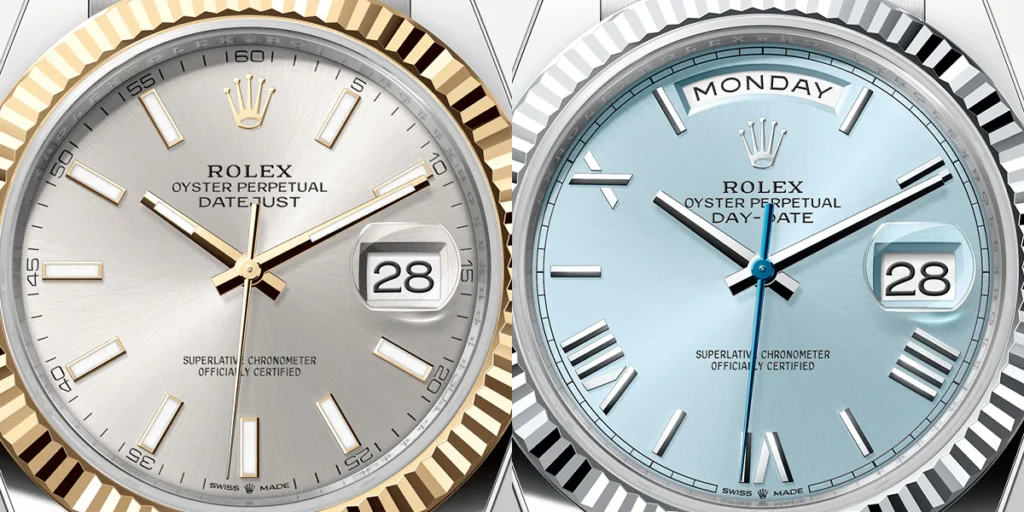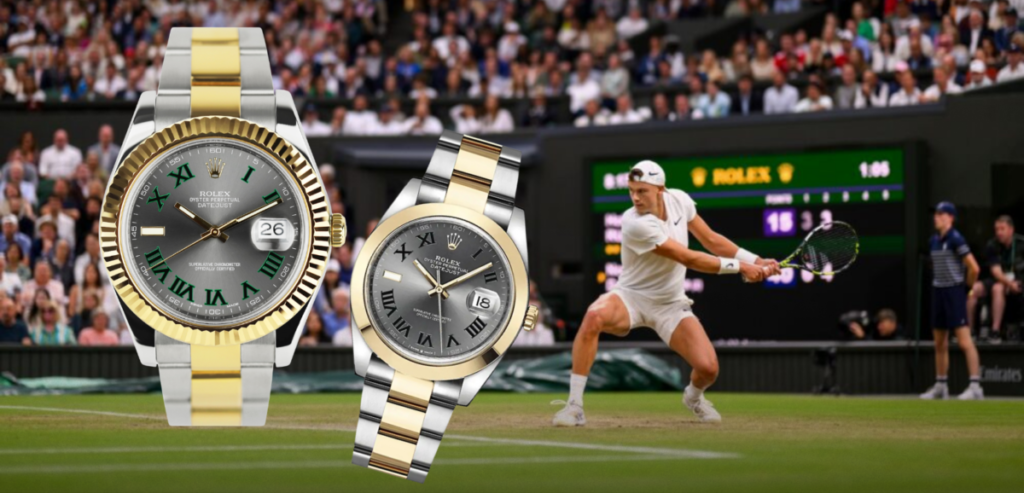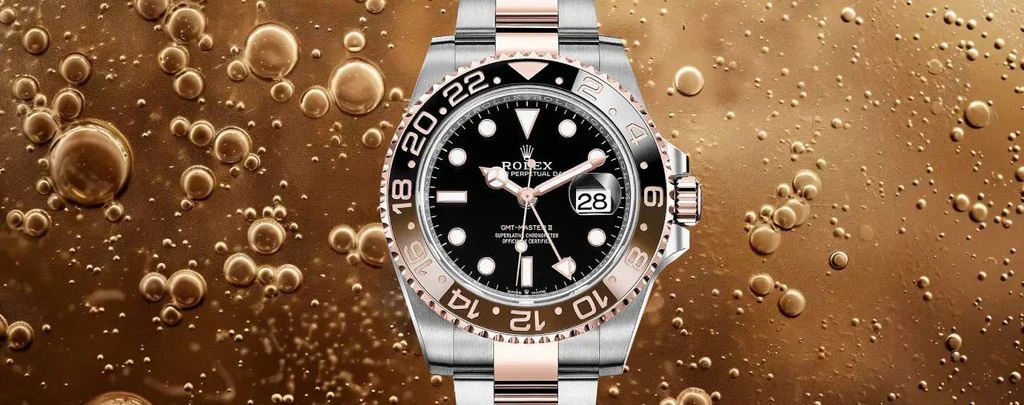
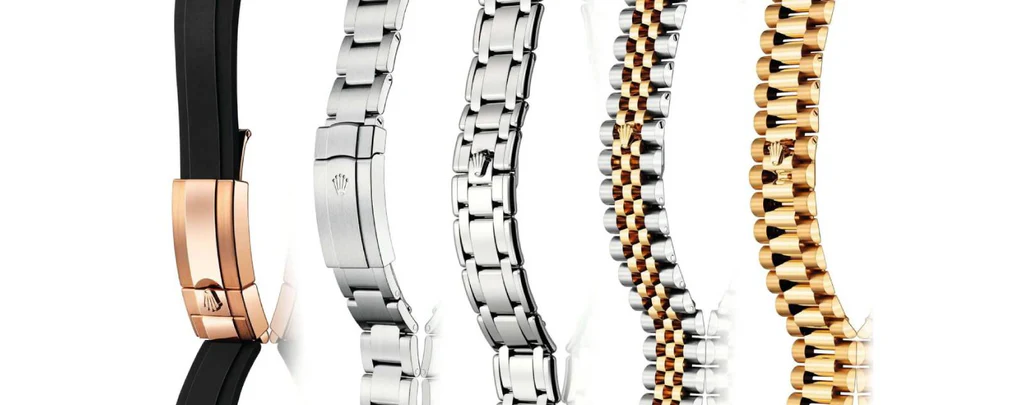
There are five Rolex bracelet types currently in production, and understanding the difference between them matters more than most buyers realise. The bracelet determines how a watch wears on the wrist, which contexts it suits, and in several cases, how much it’s worth on the secondary market. Two watches with the exact same reference number can trade thousands of dollars apart because of bracelet choice alone — the most well-known example being the GMT-Master II Batman (Oyster) versus the Batgirl (Jubilee), where the Jubilee version commands a consistent $2,000–$4,000 premium. This guide explains every Rolex bracelet type in detail: construction, character, which references it appears on, and what it means for value and wearability. Browse our current GMT and Datejust inventory to see both bracelet types on real secondary market examples, or submit a request if you’re looking for a specific configuration.
The Five Rolex Bracelet Types: Quick Reference
Before going into each Rolex bracelet type in depth, here is the full overview in one place. This table covers every bracelet currently used across the Rolex collection, the construction method, the intended context, and the key references associated with each.
| Bracelet Type | Link Construction | Context | Key References | Materials Available |
|---|---|---|---|---|
| Oyster | 3-piece flat link | Sport / professional | Submariner, Daytona, GMT Batman, Explorer | Oystersteel, gold, Rolesor |
| Jubilee | 5-piece centre-link | Dress / versatile | Datejust, GMT Batgirl, GMT Pepsi | Oystersteel, gold, Rolesor |
| President | 3-piece semi-circular | Formal dress | Day-Date only | 18k gold, platinum only |
| Pearlmaster | 5-piece rounded oval | Fine jewellery | Pearlmaster only | 18k gold only |
| Oysterflex | Elastomer over metal spine | Active sport | Yacht-Master, Daytona Everose, Sky-Dweller | Black elastomer / titanium |
Each of these Rolex bracelet types was designed for a specific purpose and context. None of them are interchangeable across the collection — each reference is designed around a particular bracelet, and the visual and functional identity of the watch depends on that pairing. A buyer who understands Rolex bracelet types before purchasing is far better positioned than one who discovers the differences after the fact. What follows is the full breakdown of every type.
Rolex Bracelet Types — Type 1: The Oyster Bracelet
The Oyster bracelet is the oldest and most iconic of all Rolex bracelet types. Introduced in 1947, it was designed as the definitive sports bracelet for Rolex’s professional tool watch line — robust, flat-linked, and engineered for daily wear in demanding environments. It has been the standard bracelet on the Submariner, Explorer, Daytona, GMT-Master II Batman, Air-King, and Sea-Dweller continuously across multiple generations.
Construction and Character
The Oyster uses a three-piece link construction: a broad, flat centre link flanked by a narrower outer link on each side. The links are solid — not hollow — which gives the bracelet its characteristic weight and resistance to stretching over years of wear. The flat surfaces are finished in alternating brushed and polished sections, creating contrast without visual complexity.
On the wrist, the Oyster sits with a slight stiffness compared to the five-link Jubilee. This isn’t a flaw — it’s intentional. The Oyster is designed to hold its shape under physical use, to resist snag, and to distribute the watch’s weight evenly across a broader surface. For buyers who wear their watches in active or outdoor contexts, the Oyster’s rigidity is a practical asset rather than a comfort compromise.
The current Oyster uses the Oysterlock clasp — a triple-blade folding system with a double security catch — and most current-generation models include the Easylink 5mm comfort extension built directly into the clasp. This allows the wearer to extend or shorten the bracelet by 5mm without tools, which is particularly useful in hot weather or during physical activity when wrist size fluctuates.
Oyster Bracelet: Which References Use It
Among all Rolex bracelet types, the Oyster has the broadest deployment across the collection. References that currently ship on an Oyster bracelet include: Submariner Date (126610LV, 126610LN), Submariner No-Date (124060), GMT-Master II Batman (126710BLNR Oyster), GMT-Master II Pepsi (126710BLRO), GMT-Master II Sprite (126720VTNR), Daytona steel (126500LN), Explorer I (124270), Explorer II (226570), Sea-Dweller (126600), Deepsea (136660), Air-King (126900), and the Milgauss (116400GV, now discontinued). Several Datejust 41 configurations also offer the Oyster alongside the Jubilee.
Oyster Bracelet: Value Impact
On references where only the Oyster is available — Submariner, Daytona, Explorer — the question of Rolex bracelet types doesn’t create a pricing split because there’s no comparison to make. Where it matters is on references offered in both Oyster and Jubilee configurations. On the GMT-Master II 126710BLNR, the Oyster (Batman) trades at $17,000–$20,000 in 2026 while the identical Jubilee (Batgirl) commands $19,500–$24,000. That $2,000–$4,000 gap is entirely driven by bracelet preference — the case, bezel, and movement are identical.
Rolex Bracelet Types — Type 2: The Jubilee Bracelet
The Jubilee is the most sought-after of the current Rolex bracelet types on several of the brand’s most in-demand references. Created in 1945 to launch alongside the Datejust — Rolex’s first self-winding wristwatch with a date complication — the Jubilee has been in continuous production for over 80 years and remains the defining bracelet of the Datejust and, increasingly, the preferred bracelet on GMT references where both options are available.
Construction and Character
The Jubilee uses a five-piece link construction: a broad polished centre link with two narrower links on each side, creating a finer, more intricate visual rhythm across the bracelet width. The five-link construction is also more flexible than the three-link Oyster — each link unit has more pivot points, which allows the bracelet to drape and conform to the wrist in a more fluid way. Most wearers find the Jubilee noticeably more comfortable for extended daily wear.
The alternating polished and brushed surfaces on the Jubilee catch light differently as the wrist moves, creating a livelier visual effect than the flat Oyster. This is part of what gives the Jubilee its more refined, dress-adjacent character — it has visual energy without being ostentatious.
The current Jubilee uses the Oysterclasp with the Easylink 5mm comfort extension — the same adjustment system as the Oyster. The clasp is a folding blade design that integrates cleanly with the bracelet’s end links, and it opens and closes with a positive, secure click.
Jubilee Bracelet: Which References Use It
The Jubilee is the primary bracelet on the Datejust 36 and 41 across all material configurations — steel, Rolesor (two-tone), and gold. It is also available on the GMT-Master II Batgirl (126710BLNR Jubilee), GMT-Master II Pepsi in some configurations, and the Rolex Oyster Perpetual in selected dial options. On the Root Beer GMT (126711CHNR), the Jubilee is the only bracelet option — the Rolesor construction of the bracelet, alternating Everose gold centre links and steel outer links, is specific to that reference.
Jubilee Bracelet: Value Impact
The Jubilee commands a secondary market premium on the GMT-Master II references where both bracelet options exist. The Batgirl premium over the Batman ($2,000–$4,000 in 2026) is the clearest example of bracelet preference driving value in the current Rolex market. On the Datejust, Jubilee and Oyster versions trade at near-equivalent pricing because both are considered natural and appropriate choices for the reference. The key insight: when a reference is available on multiple Rolex bracelet types, the bracelet that the majority of buyers prefer will trade higher — and on most GMT references, that’s the Jubilee.
Deciding between Jubilee and Oyster on a specific reference? Tell us which configuration you want — we source both and can give you real current pricing on either bracelet type.
Rolex Bracelet Types — Type 3: The President Bracelet
The President bracelet is the most exclusive of all Rolex bracelet types by a significant margin. It exists on exactly one Rolex reference — the Day-Date — and has been made exclusively in precious metals since it was created in 1956. It has never appeared in steel and never will. Understanding what the President bracelet is, and why it exists, requires understanding what the Day-Date is: Rolex’s most formal and prestigious watch, a piece that has been worn by heads of state, world leaders, and figures of international authority for nearly 70 years.
Construction and Character
The President uses a three-piece semi-circular link construction — each link is a smooth, rounded crescent shape with no flat surfaces or angular edges. Unlike the Oyster’s flat geometry or the Jubilee’s fine-linked intricacy, the President creates a flowing, almost sculptural line around the wrist. The links are broad and smooth, designed to present a clean, formal surface regardless of wrist position or movement.
The effect on the wrist is unmistakably formal. The President bracelet is closer in aesthetic sensibility to fine jewellery than to a sports bracelet. It is designed to sit under a dress shirt cuff, to complement formal dress, and to communicate a specific kind of quiet authority. This is not a watch for the gym or the boat — it is a watch for the boardroom, the state dinner, or the occasion that demands the most considered version of your wardrobe.
The President uses the Crownclasp — a concealed folding mechanism that integrates invisibly into the bracelet. From the outside, the bracelet presents an unbroken line of links with no visible opening point. The clasp reveals itself only when you know exactly where to press. It is one of the most elegant clasp solutions in watchmaking.
President Bracelet: Which References Use It
The President bracelet is exclusive to the Day-Date in all its current configurations: Day-Date 36 (Refs. 128238, 128235, 128239, 128349) and Day-Date 40 (Refs. 228238, 228235, 228206, 228396). It appears in yellow gold, white gold, Everose gold, and platinum — matching the precious metal of the case. No Day-Date ships on a steel bracelet; no other Rolex ships on a President bracelet. This exclusivity is structural and intentional.
President Bracelet: Value Impact
Because the President bracelet only appears on one reference — the Day-Date — there is no direct bracelet-comparison pricing dynamic as with the GMT-Master II. The President bracelet’s value contribution is inseparable from the Day-Date itself. What matters from a buying perspective: bracelet condition on a Day-Date is critical to value. An unpolished President bracelet in excellent condition contributes significantly to the watch’s secondary market appeal. A polished or stretched President bracelet reduces value meaningfully — particularly on the gold versions, where polishing removes the sharp, original finishing that Rolex specifies.
Rolex Bracelet Types — Type 4: The Pearlmaster Bracelet
The Pearlmaster bracelet occupies the most jewellery-adjacent position of all Rolex bracelet types. It was introduced in 1992 alongside the Pearlmaster collection and has never appeared on any other Rolex line. Where the Jubilee and President bracelets straddle the line between watch bracelet and jewellery bracelet, the Pearlmaster is firmly on the jewellery side of that line.
Construction and Character
The Pearlmaster uses a five-piece link construction with broader, more rounded, oval-shaped links compared to the Jubilee’s narrower centre links. The result is a bracelet that has more surface mass and a more obviously jewellery-forward appearance. The links are typically highly polished, and on many Pearlmaster configurations they are set with diamonds or coloured gemstones — turning the bracelet itself into a significant jewellery piece rather than a functional wristwatch strap.
On the wrist, the Pearlmaster is flexible and conforming due to the five-link construction, but it reads very differently from the Jubilee — more opulent, more overtly precious, less watch and more jewel. This is by design. The Pearlmaster collection targets buyers who want a Rolex that sits primarily in fine jewellery territory.
Pearlmaster Bracelet: Which References Use It
Exclusively the Pearlmaster 34 and Pearlmaster 39. Both are only produced in 18k gold configurations. The Pearlmaster bracelet has never been used on any other Rolex reference.
Rolex Bracelet Types — Type 5: The Oysterflex Bracelet
The Oysterflex is the newest of the five Rolex bracelet types and the most technically distinct. Introduced in 2015, it represents Rolex’s engineering solution for sport contexts where a metal bracelet is genuinely impractical — high-activity environments, extended water use, situations where metal-on-skin contact is uncomfortable or where bracelet wear needs to be minimised.
Construction and Character
The Oysterflex is not a rubber strap in the conventional sense. It is a high-performance elastomer moulded over a flexible titanium and nickel alloy metal spine. This internal structure gives the bracelet dimensional stability — it doesn’t stretch, sag, or lose its shape over time the way a conventional rubber strap does — while the elastomer surface provides the comfort, heat resistance, and chemical resistance that metal bracelets lack in active contexts.
The Oysterflex sits completely flat against the wrist, eliminating the metal-on-skin contact that can be uncomfortable during intense physical activity. It is resistant to salt water, sunscreen, chlorine, and UV exposure. The material maintains its properties across a wide temperature range — from cold-water diving to sun-exposed outdoor activity.
Aesthetically, the Oysterflex reads as modern and purposefully sporty. The black elastomer creates a clean, dark bracelet that complements precious metal cases — particularly Everose gold — in a way that a metal bracelet doesn’t. The contrast between the warm Everose gold case and the matte black Oysterflex is one of the most visually interesting pairings in the current Rolex collection.
The clasp uses the Oysterlock blade system adapted for the Oysterflex’s construction, with a precise micro-adjustment mechanism that sizes the bracelet without loose links or tools.
Oysterflex Bracelet: Which References Use It
The Oysterflex appears exclusively on precious metal and Rolesor references where active use is expected: Daytona Everose (126515LN, 126505), Yacht-Master 40 (126655), Yacht-Master II, and Sky-Dweller in gold and Rolesor configurations. It is not available on any steel-only reference. The Oysterflex is offered as the standard or sole bracelet option on these references — it is not an aftermarket addition.
How Rolex Bracelet Types Affect Secondary Market Value: Full Data
The connection between Rolex bracelet types and secondary market pricing is one of the most practically useful things any buyer can understand before making a purchase. Here is the current data across the references where bracelet choice creates a measurable price difference.
| Reference | Bracelet Type | Nickname | 2026 Secondary Market | Premium vs. Other Bracelet |
|---|---|---|---|---|
| 126710BLNR | Oyster | Batman | $17,000–$20,000 | Base |
| 126710BLNR | Jubilee | Batgirl | $19,500–$24,000 | +$2,000–$4,000 |
| 126710BLRO | Oyster | Pepsi | $18,000–$27,000 | Only option (base) |
| 126711CHNR | Jubilee (Rolesor) | Root Beer | $22,000–$32,000 | Only option (Rolesor premium) |
| Datejust 41 — Oyster | Oyster | — | $9,000–$11,000 | Near-equivalent |
| Datejust 41 — Jubilee | Jubilee | — | $9,500–$11,500 | Marginal Jubilee premium |
The data is clear: on references where both Rolex bracelet types are available, the bracelet the majority of buyers prefer commands a premium. On the GMT-Master II references, the Jubilee commands a consistent and significant premium. On the Datejust, the difference is marginal because both bracelet types are broadly popular on that reference. The practical takeaway: before buying a reference that offers multiple bracelet options, research which bracelet the collector market prefers — it protects both your purchase price and your eventual resale.
Bracelet Condition: What to Inspect Before Buying Any Rolex
Regardless of which of the five Rolex bracelet types is involved, bracelet condition is one of the most important assessments to make on any secondary market purchase. Poor condition affects value on every Rolex bracelet type — from the Oyster to the President — so knowing what to look for protects you at purchase and at resale. Here is what to check and why it matters.
- Polished vs. unpolished condition. Every Rolex bracelet leaves the factory with precisely specified surface finishing — some surfaces brushed, some polished, with sharp transitions between them. A bracelet that has been polished by a jeweller or watchmaker loses the original surface contrast and the sharp edge definition. Polished bracelets trade at a meaningful discount to unpolished examples. If you’re buying, ask specifically whether the bracelet has been polished. If you already own a Rolex, never let anyone polish the bracelet without understanding the value impact.
- Link stretch. On older Oyster and Jubilee bracelets — particularly examples from the 1990s and early 2000s — the links can develop excessive play and the bracelet hangs loosely from the wrist. Current-generation Rolex bracelets with solid links and tighter machining tolerances are far more resistant to stretch, but it’s worth checking on any pre-owned example over five years old.
- Spare links. Bracelets are sized at the point of sale and excess links are removed. How many spare links remain with the watch affects both wearability (buyers with larger wrists need those links) and secondary market value. Always confirm the number of spare links included in any purchase.
- Clasp integrity. The Oysterlock and Oysterclasp should open and close with a firm, positive click. The Easylink extension should engage and release cleanly. Sloppy clasp action or a clasp that doesn’t hold closed reliably indicates wear that may require servicing.
- Bracelet authenticity. On two-tone and gold references, check that the gold elements are consistent in colour and finish across all links. Mismatched links — replaced with non-genuine components — are a known frankenwatching technique on Rolesor pieces. The bracelet reference and year code stamped inside the clasp should also be verified.
Choosing Between Rolex Bracelet Types: A Practical Decision Guide
If you’re choosing between the Jubilee and Oyster — the two Rolex bracelet types most buyers encounter on crossover references — here is the honest framework most experienced buyers use. Understanding these Rolex bracelet types before you commit saves you from making a decision you’ll want to reverse at the point of resale.
Choose the Oyster if: You wear your watch in physically active contexts — sports, outdoor activities, manual work — where the bracelet will take real mechanical stress. You prefer a more overtly sport-watch aesthetic. You have a larger wrist (18cm+) where the Oyster’s broader geometry sits proportionately. You prefer the original launch configuration of a reference where the Oyster was the first bracelet option.
Choose the Jubilee if: You want the most versatile bracelet that transitions between sport and semi-formal contexts with equal comfort. You find the five-link construction more comfortable for all-day wear. You are buying primarily as a long-term investment and want the configuration that holds its value at the upper end of the range. You simply prefer the refined visual character of the Jubilee over the flat, muscular Oyster.
The honest answer for most first-time Rolex buyers looking at a reference like the GMT-Master II: look at both in person before deciding. The difference is clear in photographs but it’s experienced differently on the wrist — and most people who see both side by side know immediately which one they want.
Frequently Asked Questions: Rolex Bracelet Types
What are the different Rolex bracelet types?
Rolex currently produces five bracelet types: the Oyster (three-piece flat link, sport watches), the Jubilee (five-piece centre-link, dress and crossover references), the President (semi-circular three-piece, Day-Date exclusive, precious metal only), the Pearlmaster (rounded five-piece, Pearlmaster exclusive, gold only), and the Oysterflex (elastomer over metal spine, active sport references on precious metal cases). Each type is specific to a set of references and is not interchangeable across the collection.
Which Rolex bracelet types are the most comfortable to wear?
Among the five Rolex bracelet types, most wearers find the Jubilee the most comfortable for extended daily wear. The five-piece construction gives it more flexibility and wrist-drape than the three-piece Oyster. The Oysterflex is the most comfortable during high-activity use — the elastomer surface eliminates metal-on-skin friction and stays flat against the wrist regardless of wrist movement.
Does the Jubilee or Oyster bracelet hold its value better on a Rolex?
On references where both bracelet types are available — specifically the GMT-Master II 126710BLNR — the Jubilee (Batgirl) holds its value better and commands a $2,000–$4,000 secondary market premium over the Oyster (Batman). This reflects sustained collector preference for the Jubilee on that reference. On the Datejust, the difference is marginal. The principle: the bracelet type that most buyers prefer will trade at a premium — and on GMT references, that’s the Jubilee.
Can I change a Rolex Oyster bracelet to a Jubilee bracelet?
Technically, bracelet swaps are possible if the lug width matches. However, a Rolex watch presented with a non-original bracelet configuration trades at a significant secondary market discount compared to an original-bracelet example. If bracelet type matters to your buying decision, source the reference in the configuration you want from the outset rather than swapping after purchase.
What Rolex bracelet types come on the Datejust?
The Datejust 36 and 41 are both available from the factory on either the Jubilee or Oyster bracelet. The Jubilee is the traditional Datejust bracelet — it launched with the reference in 1945 — and is widely considered the more classic choice for the Datejust. Both are genuine factory configurations and both trade at comparable secondary market pricing. Rolex’s official Datejust page shows current bracelet options across the full Datejust range.
Is the Rolex President bracelet available in steel?
No. The President bracelet has only ever been produced in precious metals — yellow gold, white gold, Everose gold, and platinum — and is exclusive to the Day-Date reference. It has never been made in Oystersteel and does not appear on any other Rolex model.
The Bottom Line on Rolex Bracelet Types
Rolex bracelet types are not interchangeable accessories — they are integral design decisions baked into every reference. Each of the five Rolex bracelet types was engineered for a specific reference context, carries a distinct aesthetic and functional character, and contributes to the watch’s secondary market value in specific ways. The Oyster is the definitive Rolex sport bracelet — robust, flat-linked, purpose-built. The Jubilee is the most versatile across dress and sport contexts and the preferred bracelet on the GMT-Master II references that drive the most collector discussion. The President is precious-metal-only, Day-Date-exclusive, and one of the most distinctive dress bracelet designs in watchmaking. The Pearlmaster sits in fine jewellery territory. The Oysterflex is the modern solution for active use on precious metal sport watches.
Knowing these differences before you buy protects your purchase decision, your comfort on the wrist, and your resale value when the time comes to sell. If you’re choosing between bracelet options on a specific reference, browse our current inventory — we carry both Jubilee and Oyster configurations across the GMT and Datejust lines — or submit a request for exactly the configuration you want.
Ready to Source Your Rolex?
Let Us Find the Watch You've Been Looking For
No waitlists. No guesswork. Authenticated Rolex watches sourced directly for you.
Request a Watch