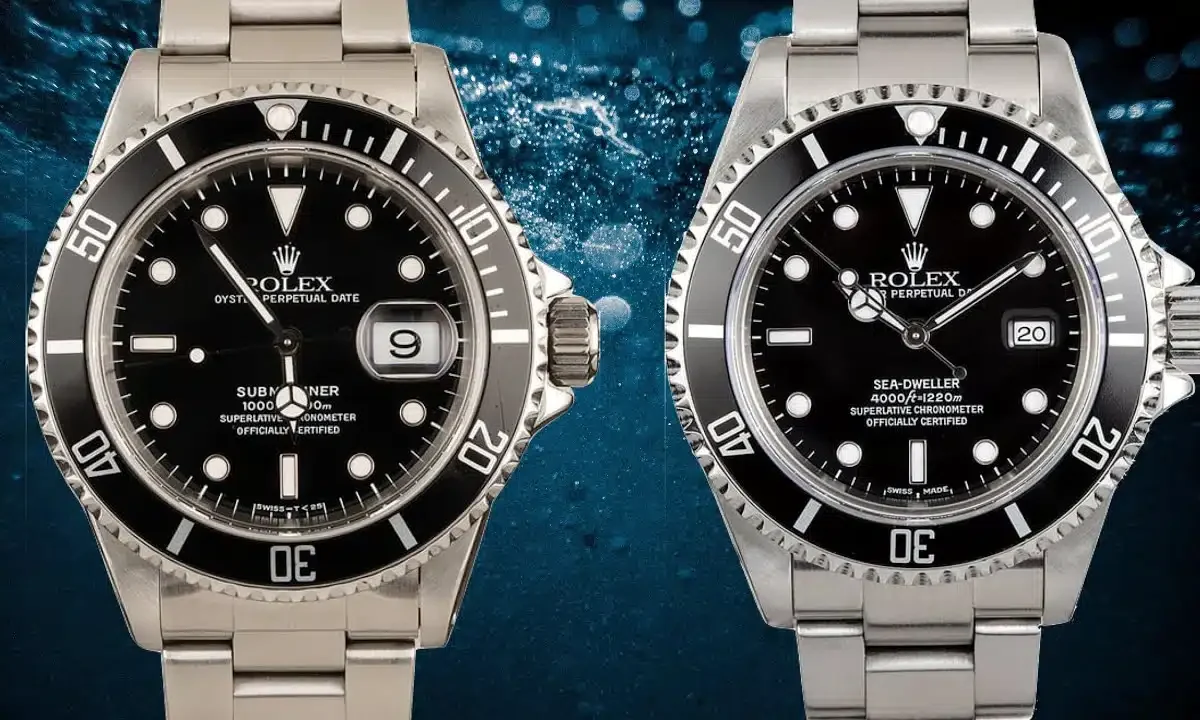
Rolex Sea Dweller vs Submariner — this is one of the most common sourcing conversations I have. It usually comes from someone who has done their research, narrowed it down to these two, and is genuinely stuck. Both have black dials. Both have rotating bezels. Both are professional dive watches that cost around $10,000–$12,000 at retail and wear as serious sport Rolexes. But they are not the same watch, they don’t wear the same way, and the decision actually matters. Take a look at our current inventory to see live examples of both while you work through the comparison.
This guide covers every meaningful difference between the Rolex Sea Dweller vs Submariner — on the wrist, on the secondary market, and for different buyer profiles. By the end you’ll know which one is the right call for you specifically.
Rolex Sea Dweller vs Submariner: Key Differences at a Glance
| Submariner Date (126610LN) | Sea-Dweller (126600) | Deepsea (136660) | |
|---|---|---|---|
| Case size | 41mm | 43mm | 44mm |
| Thickness | 12.4mm | 14.6mm | 17.7mm |
| Water resistance | 300m / 1,000ft | 1,220m / 4,000ft | 3,900m / 12,800ft |
| Helium escape valve | No | Yes (9 o’clock) | Yes (9 o’clock) |
| Cyclops lens | Yes (2.5x date magnification) | No | No |
| Movement | Caliber 3235 | Caliber 3235 | Caliber 3235 |
| 2026 retail (approx.) | ~$10,800 | ~$12,300 | ~$16,100 |
| 2026 secondary market | $13,500–$16,500 | $11,500–$15,000 | $14,000–$18,000 |
| Bracelet | Oyster with Glidelock | Oyster with Glidelock | Oyster with Glidelock |
Retail figures are approximate USD. Secondary market pricing reflects 2026 unpolished, full-set examples.
The History Behind the Rolex Sea Dweller vs Submariner Debate
To understand why these two watches exist side by side and why the Rolex Sea Dweller vs Submariner question has no single right answer, you need the context behind both.
The Submariner launched in 1953 as Rolex’s first purpose-built dive watch. It was rated to 100 metres at launch — later extended to 200m, then 300m. It defined the modern dive watch category. Everything that followed, from every other brand’s dive watch to every counterfeit Rolex ever made, traces its visual DNA to the Submariner. Seventy years later, it’s still the most recognised watch silhouette on earth.
The Sea-Dweller came later, developed through a collaboration with COMEX — a French professional diving company that was doing saturation dives at depths and durations that the standard Submariner couldn’t handle. The specific engineering problem: in saturation diving, divers breathe helium-enriched gas mixtures to avoid nitrogen narcosis at extreme depths. During decompression, helium molecules are small enough to penetrate watch seals and build up inside the case. Without a way to release that helium, a watch can lose its crystal during decompression. The Sea-Dweller’s helium escape valve (the small crown-shaped valve at 9 o’clock) solves that problem. Rolex also built a much thicker, more robust crystal and case architecture to handle the greater pressure.
Nobody buying a Sea-Dweller in 2026 is a commercial saturation diver. That’s fine — nobody buying a Submariner is an actual scuba diver most of the time either. The point is that the engineering difference is real and structural, not cosmetic. The Sea-Dweller is a fundamentally different watch under the skin, even if it looks like a larger Submariner on the surface.
The Submariner: What You’re Getting in 2026
The current Submariner Date (Ref. 126610LN) runs on Caliber 3235 — one of the best movements Rolex has ever made. 70-hour power reserve, ±2 seconds per day accuracy, Chronergy escapement for improved energy efficiency, and a paramagnetic hairspring that resists magnetic interference. You’re getting exceptional horological engineering in a case that’s 41mm across and 12.4mm thick.
That 41mm-by-12.4mm combination sits in a near-universal sweet spot. Large enough to make a clear statement and fill the wrist properly. Thin enough to slide under a shirt cuff without any conscious adjustment. Whether you’re in a boardroom or on a boat, the Submariner works. That versatility is exactly why it’s the most popular sport Rolex ever made — and why it’s still the most copied watch in history.
The Cyclops lens at 3 o’clock is the one thing that divides opinion. It magnifies the date to 2.5 times actual size, filling the window and making the date immediately readable at a glance. For practical daily use, this is genuinely useful — you don’t need to squint. But it interrupts the symmetry of the dial, and some buyers find it visually dominant in a way they don’t love.
Secondary market positioning: the Submariner Date is the most liquid Rolex in existence. Every serious buyer knows what it is. The buyer pool is deeper than any other reference. If you ever need to sell, a 126610LN in good condition with papers is one of the easiest watches in the world to move — typically within a few days at fair market pricing.
The Sea-Dweller: What Makes It a Different Watch
The current Sea-Dweller (Ref. 126600) is 43mm across and 14.6mm thick. Those extra 2mm in diameter and 2.2mm in thickness don’t sound like much on paper. On the wrist, they’re immediately felt. This is a bigger, more substantial watch than the Submariner. It occupies the wrist differently — more presence, more visual weight, more physical heft.
On a larger wrist (18cm and above), the Sea-Dweller fills the space properly. It looks proportionate and purposeful. On a smaller wrist, it can overwhelm — the combination of size and thickness makes it sit high off the wrist and creates a visual imbalance that even a great strap can’t fully correct. Wrist size is probably the single most important factor in the Rolex Sea Dweller vs Submariner decision, and buyers often underestimate how much it matters until they try both on.
No Cyclops lens. The Sea-Dweller has a flat sapphire crystal that makes the dial completely symmetrical — the date sits at 3 o’clock without any magnifying bubble above it. The effect is cleaner and more balanced. For buyers who find the Cyclops visually intrusive on the Submariner, this is the decisive advantage of the Sea-Dweller. It’s a more austere, less widely recognized face — which is exactly what some buyers want.
The helium escape valve at 9 o’clock is the visual signature of the Sea-Dweller. It’s a small additional crown-like element that most people won’t notice from a distance but that watch-literate observers immediately recognise. It signals that you chose the more technical, less mainstream option — and in watch-savvy circles, that carries genuine weight.
We source both the Sea-Dweller and Submariner regularly. Browse current availability or tell us which way you’re leaning — we’ll give you real current pricing on both and a clear sourcing timeline.
The Cyclops Debate in the Rolex Sea Dweller vs Submariner Comparison
In every Rolex Sea Dweller vs Submariner conversation I’ve had, the Cyclops lens comes up more than any other single detail. It divides buyers more sharply than size, more sharply than price, more sharply than the depth rating. People have strong feelings about it.
The case for the Cyclops: it’s functional. The 2.5x magnification makes the date genuinely easy to read at a glance. For buyers who actually check the date on their watch regularly — which most do — the Cyclops makes the Submariner more practical as a daily wearer. It’s been on the watch since 1953 and it’s part of the Submariner’s DNA at this point.
The case against the Cyclops: it breaks the dial’s symmetry. The Sea-Dweller’s flat crystal creates a completely balanced face — the dial and bezel are in visual harmony. The Cyclops introduces a bubble above the 3 o’clock position that some buyers find jarring, particularly after they’ve spent time looking at the Sea-Dweller’s cleaner layout.
My observation from working with buyers on both sides: if you’ve never owned a Rolex before, you probably don’t have a strong opinion going in and should try both on before deciding. If you’ve owned a Submariner and love the Cyclops, you’ll miss it on the Sea-Dweller. If you’ve always found it visually intrusive, the Sea-Dweller will feel like a relief.
Rolex Sea Dweller vs Submariner: Secondary Market Pricing in 2026
The secondary market data on the Rolex Sea Dweller vs Submariner comparison is genuinely counterintuitive, and it’s one of the first things I explain to buyers who expect a straightforward price-to-value relationship.
| Reference | 2026 Retail | 2026 Secondary Market | Secondary Premium |
|---|---|---|---|
| Submariner Date 126610LN (black) | ~$10,800 | $13,500–$16,500 | +25–53% |
| Submariner Date 126610LV (Kermit) | ~$10,800 | $14,500–$18,500 | +34–71% |
| Sea-Dweller 126600 | ~$12,300 | $11,500–$15,000 | Flat to +22% |
| Deepsea 136660 (black) | ~$16,100 | $14,000–$18,000 | Flat to +12% |
The Sea-Dweller retails $1,500 more than the standard Submariner. On the secondary market, the gap disappears — and sometimes reverses. The Submariner Date trades at a meaningful premium above retail. The Sea-Dweller trades near retail or at a modest premium. The Deepsea, which retails considerably higher, also shows thin secondary market premiums.
Why? Demand breadth. The Submariner has the widest buyer pool of any Rolex — experienced collectors, first-time luxury watch buyers, gifters, investors. All of them want it. The Sea-Dweller and Deepsea appeal to a narrower segment who specifically want the larger, more technical dive reference. Narrower demand means the secondary price premium compresses despite higher retail pricing.
What this means for the Rolex Sea Dweller vs Submariner decision: if secondary market value and liquidity matter to you, the Submariner wins clearly. If you genuinely prefer the Sea-Dweller, you’re often getting a technically superior, more complex watch at a similar or lower effective secondary market price. That’s actually a reasonable value proposition if the Sea-Dweller is genuinely the watch you want.
On the Wrist: How Each Watch Actually Feels
I’ve placed both references on a lot of wrists over the years. The pattern I see consistently: buyers with wrists under 17cm almost always prefer the Submariner once they’ve tried both. The Sea-Dweller at 43mm and 14.6mm is physically too present for a smaller wrist — it becomes the dominant visual element and doesn’t let the rest of an outfit breathe around it.
Buyers with wrists at 18cm and above often find the Sea-Dweller fills the space more naturally than the Submariner. The 41mm Submariner can look proportionally small on a large wrist. The Sea-Dweller’s extra size and thickness read as purposeful rather than oversized.
Bracelet feel is similar on both — both use the Oyster bracelet with Glidelock extension system, which allows about 5mm of micro-adjustment at the clasp. Neither watch has a Jubilee bracelet option (unlike the GMT-Master II variants), so bracelet preference doesn’t factor into this comparison.
Both references wear comfortably for extended periods. The Sea-Dweller is heavier, which some wearers find reassuring and others find fatiguing over a full day. It’s worth wearing a display model for an hour before deciding if you have access to one.
Who Should Buy the Submariner
In the Rolex Sea Dweller vs Submariner decision, the Submariner is the right choice if:
- You want the most versatile, recognisable, and liquid sport Rolex available
- Your wrist is under 17.5cm and you prefer a watch that doesn’t dominate your wrist
- You value Cyclops magnification for practical daily use
- Secondary market value and liquidity are meaningful factors in your decision
- This is your first sport Rolex and you want the canonical reference
- You need the watch to cross formal and casual contexts equally well
The Submariner is the correct first sport Rolex for most buyers. That’s not a criticism — it’s an acknowledgement that Rolex got the formula right in 1953 and has refined it to near-perfection over seven decades.
Who Should Buy the Sea-Dweller
In the Rolex Sea Dweller vs Submariner comparison, the Sea-Dweller makes sense if:
- You have a larger wrist (18cm+) and want a watch that fills it proportionally
- You strongly prefer the cleaner, symmetrical dial without the Cyclops lens
- You want the less mainstream dive Rolex — the one that watch people notice
- Technical specification depth matters to you (1,220m vs 300m is a meaningful gap)
- You already own a Submariner and want the more serious alternative in your collection
- You appreciate the COMEX history and what the Sea-Dweller represents technically
The Sea-Dweller buyer is usually someone who has thought carefully about the comparison and made a deliberate choice. It’s not the obvious answer — which is precisely why it carries a different kind of credibility in watch circles.
What About the Deepsea (Ref. 136660)?
The Deepsea is 44mm across and 17.7mm thick — rated to 3,900 metres. It’s a different category of watch entirely. For most buyers comparing the Rolex Sea Dweller vs Submariner, the Deepsea is simply too large and too specialised to be a practical daily wearer. It’s wearable comfortably only on the largest wrists, and even then it’s a statement piece rather than an everyday watch.
The Deepsea also carries the thinnest secondary market premium of the three — it retails at ~$16,100 and trades at roughly that level on the secondary market. The buyer pool is narrowest of all three references. Buy it if the 44mm case genuinely works on your wrist and the engineering specification appeals to you, not for investment logic.
Rolex Sea Dweller vs Submariner: The Collector’s Perspective
Experienced collectors tend to view the Rolex Sea Dweller vs Submariner question differently from first-time buyers. Within serious collecting circles, owning the Sea-Dweller signals something specific — you made the deliberate, less obvious choice. You chose the more technically rigorous reference. That’s respected.
The Submariner is the canonical piece, but it’s also the default. In a room full of watch collectors, Submariners are everywhere. Sea-Dwellers are less common and command a different kind of attention from people who know watches. If you care about how your watch reads to a watch-literate audience, that matters.
For most buyers, this consideration is secondary to fit, preference, and practical use. But it’s worth factoring in if you move in circles where watches are discussed and noticed.
Frequently Asked Questions: Rolex Sea Dweller vs Submariner
What is the main difference between the Rolex Sea Dweller vs Submariner?
The three primary differences: case size (43mm vs 41mm), the Cyclops date magnifier (Submariner has it, Sea-Dweller doesn’t), and the helium escape valve (Sea-Dweller only). The Sea-Dweller also has a substantially greater depth rating — 1,220m vs 300m — and is notably thicker at 14.6mm vs 12.4mm.
Which holds its value better — Sea-Dweller or Submariner?
The Submariner Date wins clearly on secondary market performance. It trades at 25–53% above retail with a deep buyer pool and fast sale times. The Sea-Dweller trades near retail to a modest premium. If investment value and liquidity matter, the Submariner is the stronger choice in the Rolex Sea Dweller vs Submariner comparison.
Is the Rolex Sea-Dweller worth more than the Submariner?
At retail, the Sea-Dweller is approximately $1,500 more expensive. On the secondary market, the gap often disappears — the Submariner’s larger buyer pool means it can trade at similar or higher secondary prices despite a lower retail starting point. You sometimes get a technically superior watch for a similar effective price on the secondary market.
Is the Sea-Dweller bigger than the Submariner?
Yes — 43mm vs 41mm in diameter, and 14.6mm vs 12.4mm in thickness. The size difference is modest on paper but clearly perceptible on the wrist. Wrist size is the most important practical factor in the Rolex Sea Dweller vs Submariner decision. Try both on before committing if you can.
Does the Sea-Dweller have a date window?
Yes — but no Cyclops lens to magnify it. The date sits at 3 o’clock under the flat sapphire crystal, readable but not magnified. If date readability at a glance matters to your daily use, the Submariner’s 2.5x Cyclops magnification is a genuine practical advantage.
Why does the Submariner cost more than the Sea-Dweller on the secondary market?
Secondary market pricing is driven by demand, not retail price. The Submariner has the deepest buyer pool of any Rolex. More buyers competing for similar supply produces higher secondary premiums. The Sea-Dweller appeals to a more specific buyer profile, which means the secondary premium is narrower despite the higher retail baseline.
The Verdict: Rolex Sea Dweller vs Submariner
If you’re undecided and don’t have a strong reason to lean toward the Sea-Dweller, the Submariner is the safer choice. More versatile, more liquid, works on more wrists, suits more contexts. It’s the canonical sport Rolex for good reason.
Choose the Sea-Dweller if you have a specific, considered reason — your wrist size calls for it, you’ve always disliked the Cyclops, you want the collector’s alternative, or you simply prefer its more austere face after looking at both. The Rolex Sea Dweller vs Submariner decision isn’t really about which watch is better. It’s about which one is right for you, specifically.
Both are excellent. Neither is wrong. Browse current inventory to see which references we have available right now — or tell us your preference and we’ll source it, authenticate it, and present it with full current pricing and no obligation.
Ready to Source Your Rolex?
Let Us Find the Watch You've Been Looking For
No waitlists. No guesswork. Authenticated Rolex watches sourced directly for you.
Request a Watch