The Rolex Jubilee vs Oyster bracelet is one of those decisions that sounds minor until you’re actually living with the result. It comes up near the end of almost every sourcing conversation I have — everything else is settled, the reference is chosen, the dial colour is locked in, and then it comes down to which bracelet. Most buyers underestimate how much it matters. The bracelet changes the whole character of the watch on your wrist: how it moves, how it feels after eight hours, how it ages, and on specific references, how much it’s worth when you eventually sell. Browse our current inventory to see both configurations on real watches while you work through this comparison.
This guide covers everything about the Rolex Jubilee vs Oyster bracelet decision — construction, comfort, durability, how each ages, which references offer a choice, and where the bracelet actually affects secondary market value.
Rolex Jubilee vs Oyster Bracelet: Quick Comparison
| Jubilee Bracelet | Oyster Bracelet | |
|---|---|---|
| Link construction | 5-piece links (2 outer brushed, 3 inner polished) | 3-piece links (wide flat links, brushed top) |
| Flexibility | High — drapes and flexes with wrist movement | Lower — structured, holds its shape |
| Wrist fit | Sits close to the wrist, feels like jewellery | Sits slightly further from the wrist, more robust |
| Character | Refined, dress-leaning, elegant | Sporty, clean, architectural |
| Scratch visibility | Higher — polished inner links show wear | Lower — brushed surfaces conceal scratches |
| Long-term stretch | Can develop slight play over many years | Minimal stretch, holds dimensions well |
| Best context | Business, formal, smart casual | Sport, active wear, casual |
| Secondary market effect | +$2,000–$4,000 premium on Batman GMT | Standard pricing on most references |
Rolex Jubilee vs Oyster Bracelet: The Full History
The Oyster bracelet came first. Rolex introduced it in 1935 — making it one of the earliest integrated metal watch bracelets ever produced. At the time, most watches were worn on leather straps, and a proper metal bracelet designed to integrate with the watch case was an innovation. The name tied into Rolex’s existing Oyster waterproof case system. It’s been the default bracelet on Rolex sport watches ever since, and its fundamentals have barely changed in ninety years.
The Jubilee bracelet arrived in 1945, introduced specifically to complement the Datejust — Rolex’s first watch with a date function. The Datejust needed a bracelet with more refinement than the sporty Oyster. Rolex designed the five-piece Jubilee link specifically for this purpose: more intricate, more flexible, closer to fine jewellery in character while still being robustly built. The name “Jubilee” referenced the 40th anniversary of Rolex at the time of its launch.
For eighty years, these two bracelets have defined the character split within the Rolex catalogue. Sport models get the Oyster. Dress and everyday models get the Jubilee. The GMT-Master II is the interesting case — a sport-derived watch that Rolex now offers on both, and where the Rolex Jubilee vs Oyster bracelet decision actually carries real secondary market weight.
The Jubilee Bracelet: Construction, Feel, and What to Expect
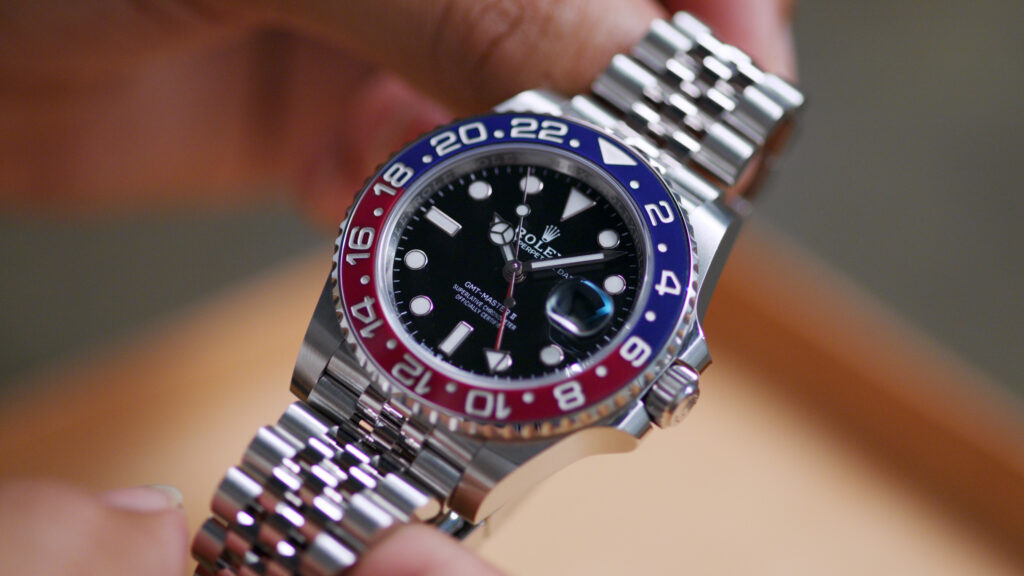
The Jubilee bracelet’s defining characteristic is its five-piece link architecture. Each section of the bracelet is made up of two outer links with a brushed top surface and three smaller inner links with a polished finish. The result is a texture that catches light differently depending on the angle — the alternating brushed and polished surfaces create a visual depth and movement that the simpler Oyster doesn’t have.
On the wrist, it drapes. That’s genuinely the best word for it. The multiple smaller links conform to the curve of your wrist more naturally than the wider Oyster. When you move your hand, the bracelet moves with you rather than sitting rigid against your arm. For buyers who’ve only worn leather straps, the first time they put on a Jubilee they often remark on how it feels alive in a way that’s unexpected from a metal bracelet.
The comfort advantages are real for extended daily wear. A Jubilee on a Datejust or GMT Batman will feel more comfortable over a full workday than the Oyster on the same reference would. The flexibility reduces the micro-pressure points that a stiffer bracelet creates when you flex your wrist repeatedly over hours.
The tradeoffs are equally real. The polished inner links are more susceptible to visible scratching than the brushed Oyster surface. If you bang your wrist on a door frame or set the watch face-down on a hard surface, the Jubilee’s polished links will show it in a way the Oyster won’t. For buyers who inspect their bracelets and are bothered by visible wear, the Jubilee requires more maintenance attention. A light professional polish every few years can restore the inner links — but that’s an added care consideration over the life of the watch.
The second tradeoff: stretch. Over many years of daily wear, the smaller Jubilee links can develop slight additional play compared to a new bracelet. Rolex has improved this materially in recent generations — current Jubilee bracelets are more resistant to stretch than older ones — but it’s something to check when buying a pre-owned example with significant wear history. A bracelet with excessive play is something to factor into your assessment of condition and value.
References that come standard on Jubilee: Datejust 36, Datejust 41, GMT-Master II Batgirl (126710BLNR Jubilee), GMT-Master II Pepsi (126710BLRO), GMT-Master II Sprite (126720VTNR), Lady-Datejust, Day-Date (President bracelet, technically a distinct variant).
Sourcing a specific bracelet configuration? Tell us exactly what you want when you submit a request — reference, dial, and bracelet. We source the precise specification. Or browse current inventory across both bracelet options.
The Oyster Bracelet: Construction, Feel, and What to Expect
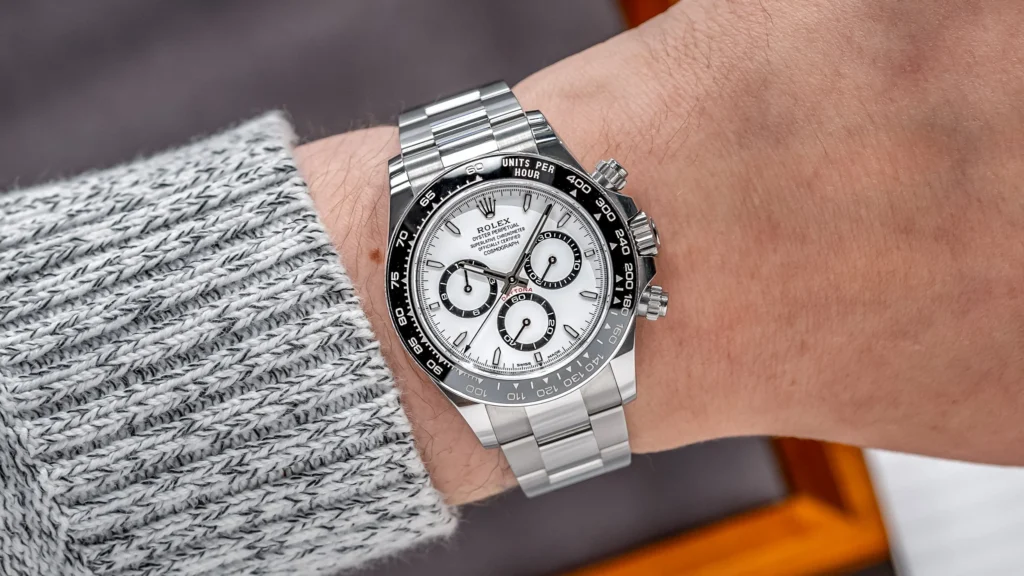
The Oyster bracelet is built around a simpler three-piece link construction: wide, flat solid links with a brushed top surface and polished flanks on the sides. Where the Jubilee is intricate, the Oyster is architecturally clean. The wider links give it a more substantial, block-like profile that reads as explicitly sporty rather than elegant.
On the wrist, the Oyster feels solid and purposeful. It sits slightly more upright — there’s less flex, less drape. It doesn’t conform to wrist curves the way the Jubilee does. Some buyers love this; it creates a feeling of wearing something robust and serious. Others find it slightly less comfortable for all-day wear than the more flexible Jubilee. There’s no universal answer here — it’s genuinely a wrist preference.
What the Oyster unambiguously wins on is durability. The wider, thicker links are significantly more resistant to long-term stretch. A well-worn Oyster bracelet from a decade ago may show surface scratches, but the bracelet structure itself will typically be tight and correct. The brushed top surfaces of the Oyster hide everyday wear better than the Jubilee’s polished inner links — scratches on a brushed surface blend in; on a polished surface they catch the light and stand out.
For physically active wearers, the Oyster is the right call every time. It’s built to be worn in real conditions, and ninety years of dive watches, pilot’s watches, and tool watches being worn hard has proven the point. If your watch is going to be exposed to work, sport, and genuine daily punishment, the Oyster handles it better.
On sport references, the Oyster is also visually correct in a way that matters. The Submariner on an Oyster bracelet is the definitive image. The proportions of the wide links against the 41mm case, the way the end links integrate with the lugs — it’s been refined over decades to be exactly right for that reference. A Submariner on a Jubilee would look wrong to anyone who knows the watch. The same is true for the Daytona, the Explorer, and the Sea-Dweller. These watches were designed for the Oyster.
References that come standard on Oyster: All Submariner references (124060, 126610LN, 126610LV), all Daytona references (116500LN, 126500LN), Explorer I (124270), Explorer II (226570), Sea-Dweller (126600), Deepsea (136660), GMT-Master II Batman Oyster version (126710BLNR).
Rolex Jubilee vs Oyster Bracelet: How Each One Ages Over Time
Buying a pre-owned Rolex means you’re buying a bracelet with history. How the two bracelets age differently is practical knowledge for any secondary market buyer.
The Jubilee ages more visibly. The polished inner links accumulate micro-scratches over years of wear that catch light and read as dullness compared to a new bracelet. The outer brushed links fare better — brushed surfaces are more forgiving of everyday wear — but the overall impression of a well-worn Jubilee is more marked than a well-worn Oyster. This isn’t necessarily a problem; some buyers actively prefer the patina of a lived-in Jubilee. But it’s worth knowing when you’re assessing condition on a pre-owned piece.
The Oyster ages more gracefully for most buyers. The brushed surfaces naturally conceal minor scratches, and the wider links show proportionally less wear than the finer Jubilee links. A decade-old Oyster bracelet with normal wear looks like a used watch; it doesn’t necessarily look neglected. The structural integrity of the Oyster also holds up better — the bracelet remains tight and close to original dimensions longer than the Jubilee under comparable wear conditions.
What to check on a pre-owned Jubilee: hold the bracelet at both ends and gently test for play in the links. Some movement is normal, but significant sloppiness suggests stretch. Also inspect the polished inner links under good light — they’ll tell you how carefully the watch was worn.
What to check on a pre-owned Oyster: flex the bracelet and check for consistent resistance throughout. Individual links shouldn’t have significantly more or less movement than their neighbours. Check the clasp mechanism — Rolex Easylink and Glidelock clasps have several moving parts, and a worn clasp is more expensive to address than a scratched link.
Rolex Jubilee vs Oyster Bracelet: The Investment Angle
For most references, the Rolex Jubilee vs Oyster bracelet choice has minimal impact on secondary market value. Both are genuine factory options, both are desirable, and buyers exist for both configurations. But there are two cases where bracelet choice has a measurable financial consequence:
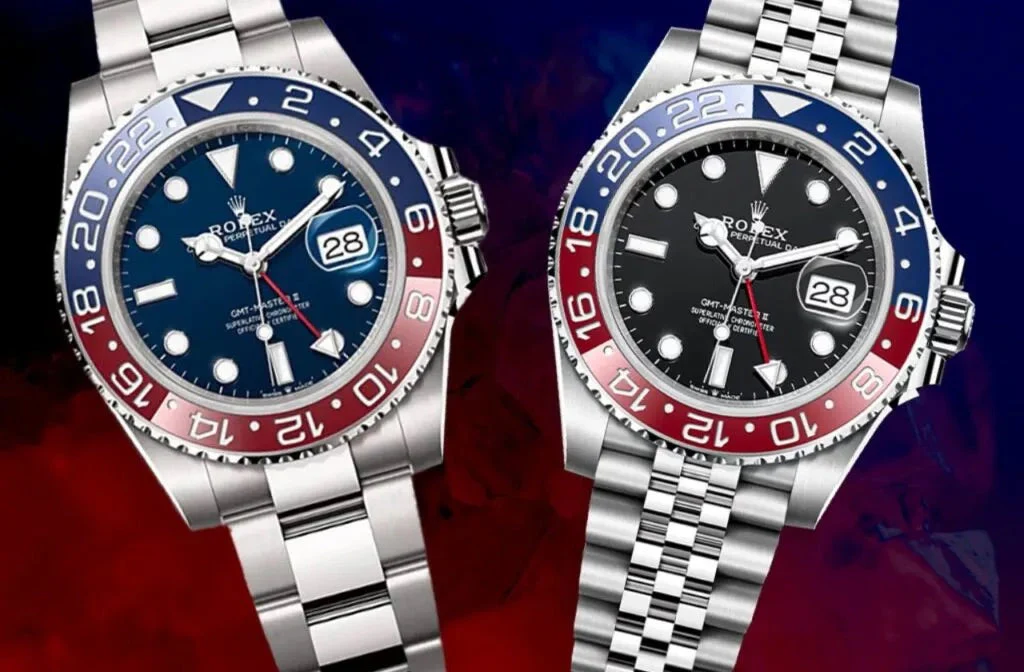
GMT-Master II Batman (126710BLNR): This is the most significant bracelet-driven price differential in the current Rolex catalogue. The Jubilee variant — which collectors call the “Batgirl” — commands a consistent $2,000–$4,000 premium over the Oyster Batman on the secondary market. This premium has been stable since the Jubilee version launched in 2021 and shows no signs of narrowing. The reason is straightforward: collector preference for the Jubilee on this specific reference is strong and consistent. More buyers want the Jubilee Batman than the Oyster Batman, and that demand differential sustains the premium.
If you’re deciding between the Batman Oyster and Batman Jubilee for investment purposes, the Jubilee is the stronger choice. The upfront premium you pay is typically recovered and then some at the point of sale.
Datejust configurations: Specific Datejust 41 references have strong collector preference for original bracelet configuration. The Wimbledon dial (126334) in its standard white gold fluted bezel / Jubilee bracelet configuration is the most notable case — an aftermarket Oyster bracelet on this reference reads as non-original to a knowledgeable buyer and affects resale. Original factory configuration matters on dial-bracelet pairs where the combination is well-established and desirable.
For all other references, bracelet choice is a lifestyle decision rather than an investment one. Buy what you’ll enjoy wearing. The secondary market will absorb either configuration at comparable pricing.
Rolex Jubilee vs Oyster Bracelet: Clasp and Adjustment Systems
Both bracelets use the Oysterlock safety clasp system — a double-locking mechanism that prevents accidental opening. The difference is in the fine adjustment systems available.
Easylink (Jubilee and Oyster, certain references): A 5mm extension built into the clasp, activated by releasing a small lever. Useful for brief adjustments — wearing a watch over a wetsuit, or accommodating wrist size variation across seasons. The extension is single-step, not micro-adjustable.
Glidelock (Oyster, dive references — Submariner, Sea-Dweller): A more sophisticated system that allows approximately 20mm of micro-adjustment in 2mm increments, all within the clasp. There’s no visible extension — the bracelet just adjusts seamlessly. This is more practical for dive use over a wetsuit and for everyday adjustment without tools.
The Jubilee bracelet uses the Easylink system on most current references. For wearers who frequently adjust bracelet length — for season, activity, or preference — the Glidelock Oyster on sport references offers more precision.
Which References Give You a Choice Between Jubilee and Oyster?
Most Rolex references don’t give you a bracelet choice — they come on one or the other from the factory. The references where the Rolex Jubilee vs Oyster bracelet decision is genuinely in play are:
| Reference | Factory bracelet options | Recommendation |
|---|---|---|
| Datejust 36 (126200) | Jubilee or Oyster (both factory) | Jubilee for dressed use; Oyster for casual |
| Datejust 41 (126300, 126334) | Jubilee or Oyster (both factory) | Jubilee for most buyers; original config for specific dials |
| GMT Batman (126710BLNR) | Oyster (Batman) or Jubilee (Batgirl) | Jubilee for investment; either for personal wear |
| Submariner (all) | Oyster only | No choice — Oyster is correct and definitive |
| Daytona (all) | Oyster only | No choice — Oyster is correct and definitive |
| Explorer I/II | Oyster only | No choice |
Rolex Jubilee vs Oyster Bracelet: How to Actually Decide
The fastest way to resolve the Rolex Jubilee vs Oyster bracelet question is to put both on your wrist. Everything I’ve written above is useful context, but the moment most buyers feel the difference, the decision becomes obvious. The Jubilee drapes; the Oyster sits. Whether that distinction appeals to you or not is immediate and personal. There’s no guide that can replace 10 minutes of wearing each one.
If you can’t try both on first, here’s the practical framework:
Buy the Jubilee if: your primary wearing contexts are business, formal events, or smart casual. You want maximum comfort for extended daily wear. You’re buying the GMT-Master II Batman and investment performance matters. You’re drawn to the refined, jewellery-like texture of the five-piece link.
Buy the Oyster if: your lifestyle involves sport, physical activity, or outdoor environments. You prefer clean, architectural aesthetics over the more intricate Jubilee texture. You’re buying a Submariner, Daytona, or Explorer — where the Oyster is the only factory option and the correct aesthetic choice regardless. You want the bracelet that shows the least visible wear over time.
When genuinely undecided on a Datejust: most buyers who are uncertain before the purchase become certain the moment they wear it. Try it in person if at all possible. The Rolex Jubilee vs Oyster bracelet question is almost always settled by feel, not by reading.
Frequently Asked Questions: Rolex Jubilee vs Oyster Bracelet
Is the Jubilee or Oyster bracelet more comfortable?
The Jubilee is generally considered more comfortable for extended daily wear — its five-piece flexible construction drapes closer to the wrist and moves more naturally with wrist flexion. The Oyster is solid and well-fitted but sits slightly more rigidly. Both are comfortable; the Jubilee is the softer, more jewellery-like experience.
Which Rolex bracelet is more durable — Jubilee or Oyster?
The Oyster. Wider links, brushed surfaces that hide wear, and a construction that resists long-term stretch more effectively. For active, physical lifestyles and daily hard wear, the Oyster is the better long-term choice. The Jubilee is durable — it’s not fragile — but the Oyster is built for more demanding conditions.
Does the Rolex Jubilee vs Oyster bracelet choice affect resale value?
For most references, no — both configurations trade at comparable secondary market prices. The significant exception is the GMT-Master II Batman (126710BLNR), where the Jubilee version commands a $2,000–$4,000 premium. For Datejust references with specific dial-bracelet pairings, original factory configuration matters to knowledgeable buyers.
Can I swap a Rolex bracelet from Jubilee to Oyster (or vice versa)?
Yes — both bracelets use the same 20mm lug width on compatible references and can be swapped. However, from an investment and value standpoint, original factory configuration is always preferable. A bracelet swap is detectable by a knowledgeable buyer and typically reduces value slightly compared to an original-configuration example. Rolex also charges for bracelet swaps at service centres, and genuine Rolex replacement bracelets are not inexpensive. Worth doing if you genuinely prefer a different bracelet; not worth doing if investment preservation matters.
What is the difference between a Jubilee and Oyster bracelet on the Datejust?
Both are factory options on the Datejust. The Jubilee gives the watch a more refined, elegant character with its flexible five-piece links. The Oyster gives it a cleaner, sportier look with wider flat links. Most Datejust buyers default to the Jubilee because it suits the reference’s character — but the Oyster on a Datejust is a distinctive, slightly more understated choice that many experienced collectors prefer.
Why does the GMT-Master II Jubilee cost more than the Oyster version?
The Jubilee GMT-Master II commands a secondary market premium because collector preference for the Jubilee bracelet on that reference is strong and consistent. Both the Batgirl (Jubilee Batman) and the Pepsi come on Jubilee as standard, and both trade at premiums above their Oyster counterparts. Supply of Jubilee GMT references is also slightly tighter — Rolex allocates fewer Jubilee units to authorised dealers — which reinforces the secondary market premium.
Which Rolex bracelets come on a Submariner?
All Submariner references — current and historical — come exclusively on the Oyster bracelet from the factory. The Submariner has never been offered on a Jubilee. Any Submariner wearing a Jubilee has had a bracelet swap performed, which is non-original and reduces collector value.
The Verdict: Rolex Jubilee vs Oyster Bracelet
The Rolex Jubilee vs Oyster bracelet decision comes down to two things: the reference you’re buying and what kind of wearer you are. If the reference makes the choice for you — Submariner, Daytona, Explorer — there’s no decision to make. If you have a genuine choice (Datejust, GMT Batman), the deciding factor is how you wear your watch and which feel you prefer on your wrist.
The Jubilee is more refined, more flexible, more comfortable for long dressed wear, and currently more valuable on the GMT-Master II Batman. The Oyster is more durable, more appropriate for sport and active use, cleaner in aesthetics, and the definitive choice for Rolex’s sport references. Neither is objectively better — they’re designed for different contexts and different buyers.
When you source through us, tell us the exact bracelet you want and we’ll find it. Browse available inventory with both configurations or submit a request with your full specification — reference, dial, bracelet — and we’ll source it precisely.
Ready to Source Your Rolex?
Let Us Find the Watch You've Been Looking For
No waitlists. No guesswork. Authenticated Rolex watches sourced directly for you.
Request a Watch